


Janna Salokangas
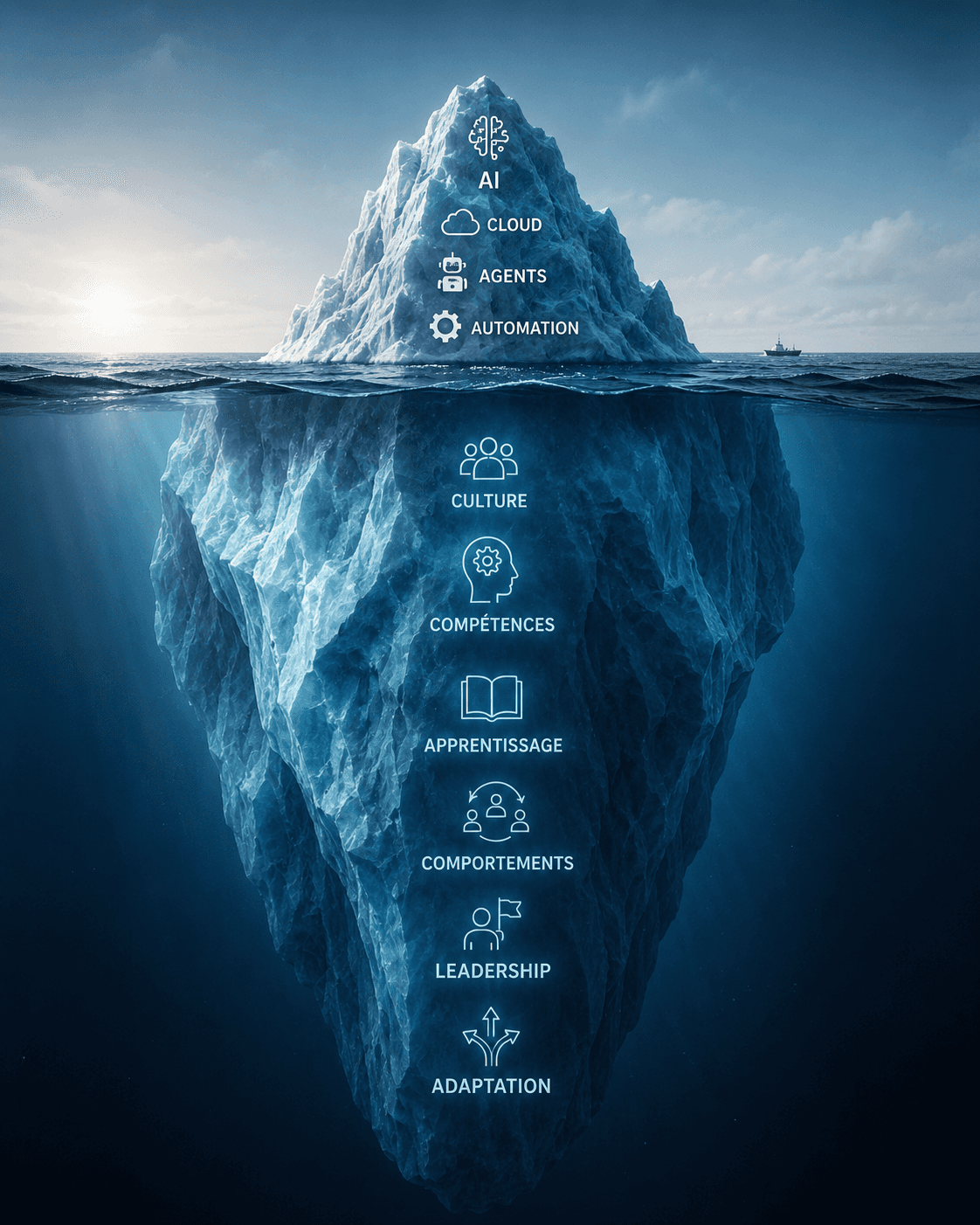
Organizations are spending billions on AI transformation and measuring almost none of what actually makes it work. HAPI is the first tool built to change that.
Here is what we’ve seen inside some of the world’s most serious organizations. They had deployed the tools. Hired the consultants. Run the pilots. And announced their AI strategies.
And then we’d go back six months later and find the same people doing their work the same way they always had.
Not because they were resistant. Not because they were incapable. But because nobody asked the harder question underneath the adoption question.
Are your people actually capable of evolving with AI? Not just using it: evolving with it?
This is not a technology failure. The technology works. The gap is something else entirely - and closing it is the most important, least addressed problem in AI transformation right now.
· · ·
AI is the most powerful capability multiplier in human history. That sentence gets said a lot. What doesn’t get said enough is its corollary: a multiplier only works if there’s something worth multiplying.
Right now, organizations are investing enormous resources in the AI side of that equation while leaving the human side completely unmeasured. They are deploying intelligent systems hoping that adoption will produce transformation, that usage will produce capability, that familiarity will produce leverage.
It won’t. Not at the scale they need. Not at the speed they’re facing.
The organizations winning with AI are not the ones with the most access to tools. They are the ones where the humans directing those tools have developed genuine capability, not just comfort. There is a profound difference between the two, and almost no one is measuring it.
Here is what we know after working with thousands of professionals across 65 countries: the people who thrive in the age of AI are not the most technical. They are the most human, and they know exactly how to direct AI to amplify their impact. They know what to direct AI toward and how to make it work for them.
They think critically when everyone around them is outsourcing their thinking. They lead when the path is unclear. They make the judgment calls no model can replicate, and they know how to direct AI to amplify them and their people.
Judgment. Creativity. Adaptability. Emotional intelligence. The ability to build trust in rooms full of anxiety and change. At Mia AI, we call these the Power Skills of the future. They were never soft. They were always the force that directs intelligence, human or artificial. We just spent decades treating them as secondary. AI has ended that era.
“You cannot develop what you cannot see. And right now, most organizations are flying completely blind on the capabilities that matter most.”
That is why we built HAPI.
The Human-AI Potential Index is the first assessment purpose-built to measure the human layer of AI transformation. Not your tools. Not your budget. Not your automation roadmap. Your people and the extraordinary potential they are sitting on right now.
HAPI looks at five dimensions of human capability, what we call the Five HAPI Powers. Together they give you a complete picture of where someone genuinely stands: what they’re strong in, where the gaps are, and what needs to happen next to move them forward. It is not a test or a ranking. It is a map. And for the first time, it makes the invisible visible.
· · ·
I want to be direct about something.
There is a story being told about artificial intelligence that I find deeply troubling. A story about replacement. About inevitability. About humans as the inefficient variable in a system that is learning to work around them.
I reject that story entirely. Not out of optimism out of evidence. I have spent years inside organizations watching what AI can and cannot do.
I have watched what happens when real humans with real judgment, real creativity, and relational intelligence that cannot be compressed into a training set learn to direct AI toward what actually matters. The result is not replacement. It is amplification. People are becoming more distinctly themselves, more capable, more essential, because of what they bring to AI not in spite of it.
“The future of work is not a story about what AI will take from us. It is a story about what we choose to build with it - and who we can become because of it.”
That choice requires knowing where you stand, being honest about what needs to grow, and treating human capability with the same rigor we bring to technology.
Over the next five articles, I’m going deep on each of the Five HAPI Powers. Real capabilities, real stakes, real people building and struggling with them right now.
We’ll start with AI Power because the most dangerous thing happening in organizations today is not that people aren’t using AI. It’s that they’re using it wrong.
The gap between who you are and who you can become because of AI is closable. But only if you can see it.
Find out where you actually stand.
About