

Mia Editorial Team

The dominant narrative about Artificial Intelligence (AI) and the future of work has been running in one direction for years: AI automates tasks, junior roles disappear, young workers struggle to start a career.
PwC's 2026 Global AI Jobs Barometer tells a more complicated story. Entry-level jobs are not disappearing. They are being rewritten into roles that require judgment, leadership, and strategic thinking that used to take a decade to develop.
PwC calls this "seniorization." For organizations thinking seriously about workforce AI readiness and the AI skills gap widening inside their structures, it changes everything.
The ladder did not break. It moved to the top floor. And most organizations are still training people for the bottom rung.
What Seniorization Actually Means
PwC analyzed 2.4 million entry-level job postings in the United States and found that roles with high AI exposure are now seven times more likely to require skills traditionally associated with experienced workers: leadership, stakeholder management, strategic decision-making, and judgment under uncertainty (PwC, 2026).

In the most AI-exposed occupations, 52% of new skills appearing in entry-level postings were traditionally tied to mid-career or senior professionals. In the least exposed, that figure was 7%. Job openings for seniorized entry-level roles have grown 35% since 2019. Conventional entry-level openings shrank 10% over the same period.
The total number of early-career postings is still growing: approximately 11 million globally in 2025, up from 7.3 million in 2018. But as Pete Brown, PwC's Global Workforce Leader, put it: "The story isn't that entry-level work is disappearing. It's that the skills employers are looking for are evolving."
The doors are open. They are narrower than the headlines suggest.
Why the Apprenticeship Model Got Deleted
AI does not begin by automating the highest-judgment work. It begins with the routine, the repeatable, and the well-defined. First-draft analysis. Document review. Data cleanup. The tasks that junior employees historically performed for two to three years before being trusted with more consequential decisions.
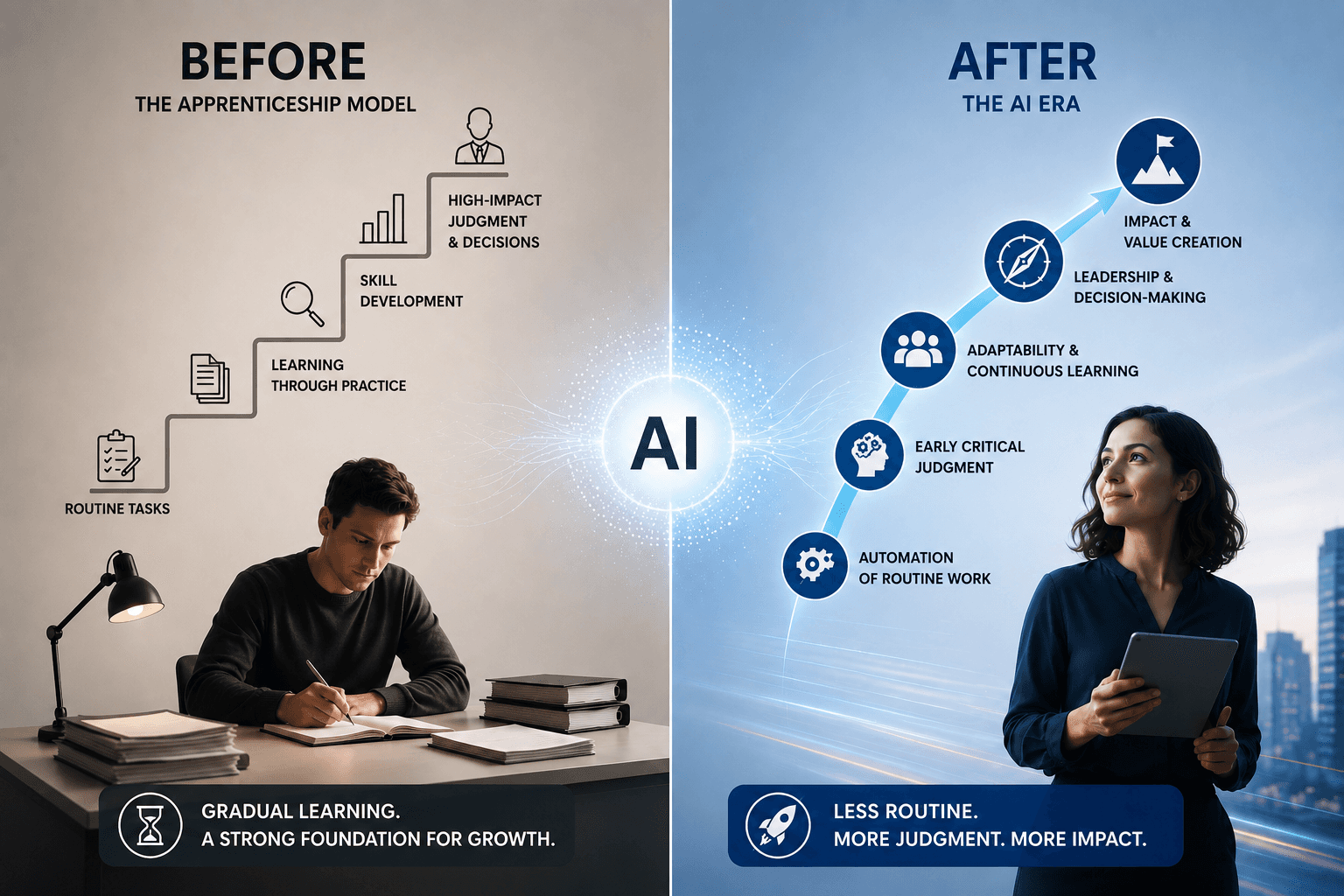
Those tasks were not just work. They were the training ground. Integrating AI into human workflows removes the routine layer, and with it the scaffold through which early-career professionals built the contextual knowledge, pattern recognition, and professional judgment that made them effective at higher-value work.
This is a skills transformation that no hiring memo can reverse. As Pete Brown noted: "AI is removing some of the routine work that once acted as an apprenticeship, while increasing demand for judgment, leadership and adaptability much earlier in careers" (PwC, 2026).
Judgment cannot be downloaded. It has to be built deliberately.
Two Tracks, Two Very Different Futures
Seniorization is one symptom of a larger shift: AI is sorting jobs onto two fundamentally different tracks.
Professionalized roles
AI automates the routine and amplifies human expertise. The role becomes more valuable. These jobs see twice the growth in available positions and 42% faster salary growth. The most AI-exposed companies are growing headcount faster than the least exposed (52% vs 36%) and wages faster (24% vs 17%).
Democratized roles
AI makes the work easier for non-experts to perform. The specialization that once commanded a wage premium erodes. Demand and wage growth trail the professionalized track significantly.
The financial signal is unambiguous. Roles requiring AI skills command a 62% wage premium and are growing eight times faster than the overall jobs market. As Joe Atkinson, Global Chief AI Officer at PwC, put it: "The companies seeing the greatest returns on AI are using it to amplify human expertise, accelerate innovation and create entirely new sources of value" (PwC, 2026).
The question every organization should be asking: which track are our roles on? The answer determines where AI upskilling investment creates returns, and where it does not.
What Organizations Are Getting Wrong
Most organizations have responded to AI by purchasing tools and deploying corporate AI training programs. Both are necessary. Neither is sufficient.

The skills driving 163% labor productivity gains at the highest-performing AI-exposed companies are judgment, leadership, creativity, adaptability, and the capacity to direct AI output toward consequential decisions. Not prompt engineering. Not platform fluency.
And the AI skills gap inside an organization is not uniform. The AI upskilling priorities of a team on the professionalized track are fundamentally different from those on the democratized track.
A uniform program cannot address both. Bridging the AI talent gap requires more than tool fluency: it requires developing the human capabilities that AI cannot replicate, and that the market is pricing at a significant premium.
Building Early-Career Judgment Deliberately
If AI has removed the routine work that once built judgment gradually, organizations must create the conditions for that development deliberately. That means rethinking several assumptions at once.
Stop assuming the junior pipeline trains itself. Early-career capability now requires structured mentorship and deliberate exposure to complex decisions, not learning by osmosis.

• Audit what you are actually asking of entry-level candidates. If job descriptions demand leadership and strategic judgment from new graduates, organizations must either hire more selectively or close that gap through targeted AI training programs.
• Design learning by function and by level. The skills a junior on a professionalized track needs, including judgment, AI-powered decision making, and stakeholder communication, are not the same as those on a democratized track. Human-AI collaboration looks different in a recruiting team than in an IT services team.
• Measure capability development, not course completion. The gap PwC identifies is not a knowledge gap. It is a capability gap. Closing it requires assessing whether employees can exercise judgment in context.
This is precisely where Mia AI is built to help. Rather than deploying a single AI literacy program across an entire workforce, Mia designs function-specific, level-specific capability journeys that develop the judgment, adaptability, and applied AI skills the professionalized track demands, starting from where each team actually is.
The Best Day to Start Is Today
PwC's 2026 Global AI Jobs Barometer is not a warning about AI replacing workers. It is a signal about a skills transformation already underway, one that is raising the bar faster than most talent development strategies can follow.
AI is not removing the need for human judgment. It is demanding it earlier, at every level of the organization. The companies that learn to build that judgment deliberately, rather than wait for it to accumulate, are the ones that will still have a pipeline when the bar rises again.
The best day to start was yesterday. The second best day is today.
Sources
PwC. (2026, June 15). 2026 Global AI Jobs Barometer. PwC. https://www.pwc.com/gx/en/news-room/press-releases/2026/pwc-2026-ai-jobs-barometer.html
PwC. (2026). 2026 Global AI Jobs Barometer: full report. PwC. https://www.pwc.com/gx/en/services/ai/ai-jobs-barometer.html
Fortune. (2026, June 18). Entry-level work didn’t disappear, PwC finds with ‘seniorization.’ Fortune. https://fortune.com/2026/06/18/entry-level-work-ai-pwc-seniorization-report/
About