

Janna Salokangas
AI, identity, and the leadership decision that will define the next economy
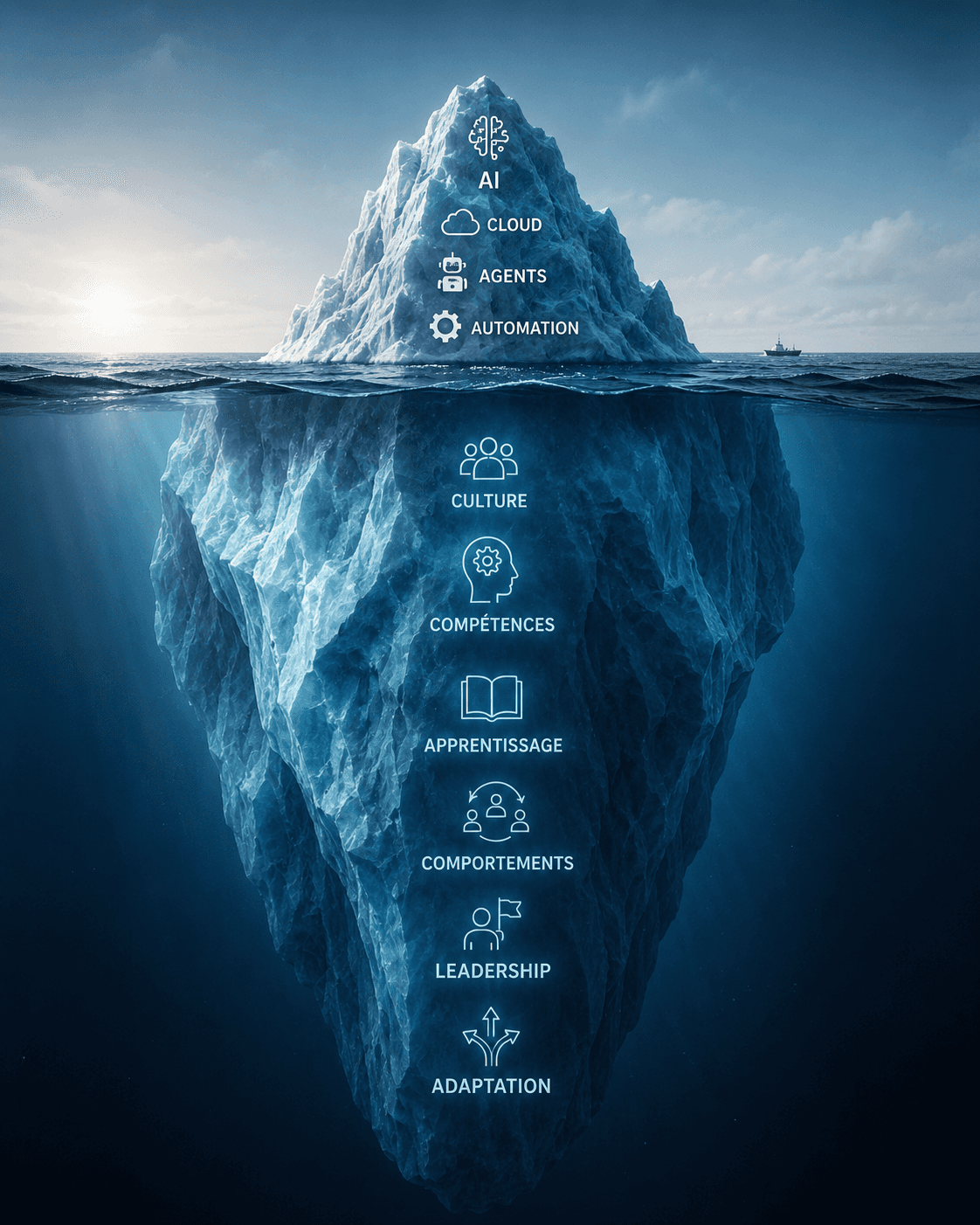
There’s a moment I keep noticing. A leader walks me through their AI roadmap with the intensity once reserved for product launches or market expansion. Speed. Advantage. Scale. Then, almost casually: “Of course, we’ll bring people along.” As if humans are luggage.
I don’t say that critically. I run an AI company. I believe deeply in this technology. I’ve seen it expand capability faster than any invention in modern history. But that sentence reveals something important: AI didn’t create a system that treats humans as secondary. It exposed one that already did.
Now we have a choice. AI can either upgrade human potential or formalize human irrelevance. The outcome will not be decided by technology. It will be decided by design.
We are not entering the automation era. We are entering the design era. We rarely live through moments like this, and it may also be the greatest opportunity of our lifetime. The future of work is being invented now. The real question is: what are we actually freeing people into?
We keep repeating a comforting story: AI will free humans for creativity, empathy, and purpose. But most workplaces are still built for output, control, and efficiency. So the question isn’t what AI removes. The question is what we replace it with. AI expands capacity. Organizations decide whether that becomes growth or simply more work. For the first time in history, productivity can increase without demanding more human exhaustion, but only if we intentionally redesign work.
The pressure beneath the excitement
Right now, professionals aren’t just learning new tools. They’re trying to stay valuable in a world where capability evolves faster than job descriptions. Entry-level pathways are shrinking. Experience requirements are rising. Rest feels risky. This isn’t resistance to technology, it’s a transition.
Every industrial revolution reduced the value of effort and increased the value of judgment. AI is the first to do it to thinking itself. We are not watching work disappear. We are watching the definition of contribution move upward.
The real disruption: meaning
In creative industries, we see it clearly. When a machine can replicate the style of a lifetime’s work in seconds, the fear isn’t economic. It’s existential. Humans don’t experience work as a collection of tasks. They experience work as meaning.
So when organizations say, “AI replaces tasks,” people hear, “AI replaces me.” That’s not resistance. It’s a communication failure. And it misses the deeper truth: AI doesn’t replace the human part of work. It removes the parts that were never uniquely human, creating space for the parts we never had time to develop. Leadership must learn to hear that signal rather than manage it away.
We are building cognitive infrastructure
AI is no longer just software. It is becoming decision infrastructure. It will negotiate, diagnose, allocate resources, set prices, filter information, and shape opportunity. That raises the bar from technical governance to moral architecture, because the real risk of AI is not intelligence, it is optimization without values.
Yet this is also the opportunity. For the first time, we have the technical ability to design decision systems around human outcomes and expanded capability, not just efficiency. The technology enables it. Our incentives still have to choose it. We are not only automating decisions. We are choosing the principles those decisions will scale. Intelligence is becoming abundant. Wisdom becomes the scarce resource.
The deeper shift: agency
AI doesn’t only change what we do. It changes how we understand ourselves. When systems begin suggesting what we think, feel, and choose, assistance can quietly become substitution. The real danger isn’t skill loss. It's an agency loss.
But AI can also do the opposite. It can make unconscious habits visible and therefore intentional. The deepest opportunity of the AI era isn’t automation. It’s the expansion of human potential.
The leadership decision
AI can unlock meaningful work, but only if we redesign the environments where work happens. You cannot center humanity inside a system designed to minimize humans.
So the real question is no longer, Can AI create a better future of work? The real question is: Do leaders have the courage to redesign the conditions required for one?
Previous generations of leaders managed resources. This generation must design human potential.
What leadership must become
Leading in the AI era is not about adoption speed. It is about architectural responsibility.
From implementation to human continuity. Before automating a task, map what changes in identity, trust, and motivation.
From productivity to capability. Measure whether people are becoming more capable, not just more efficient.
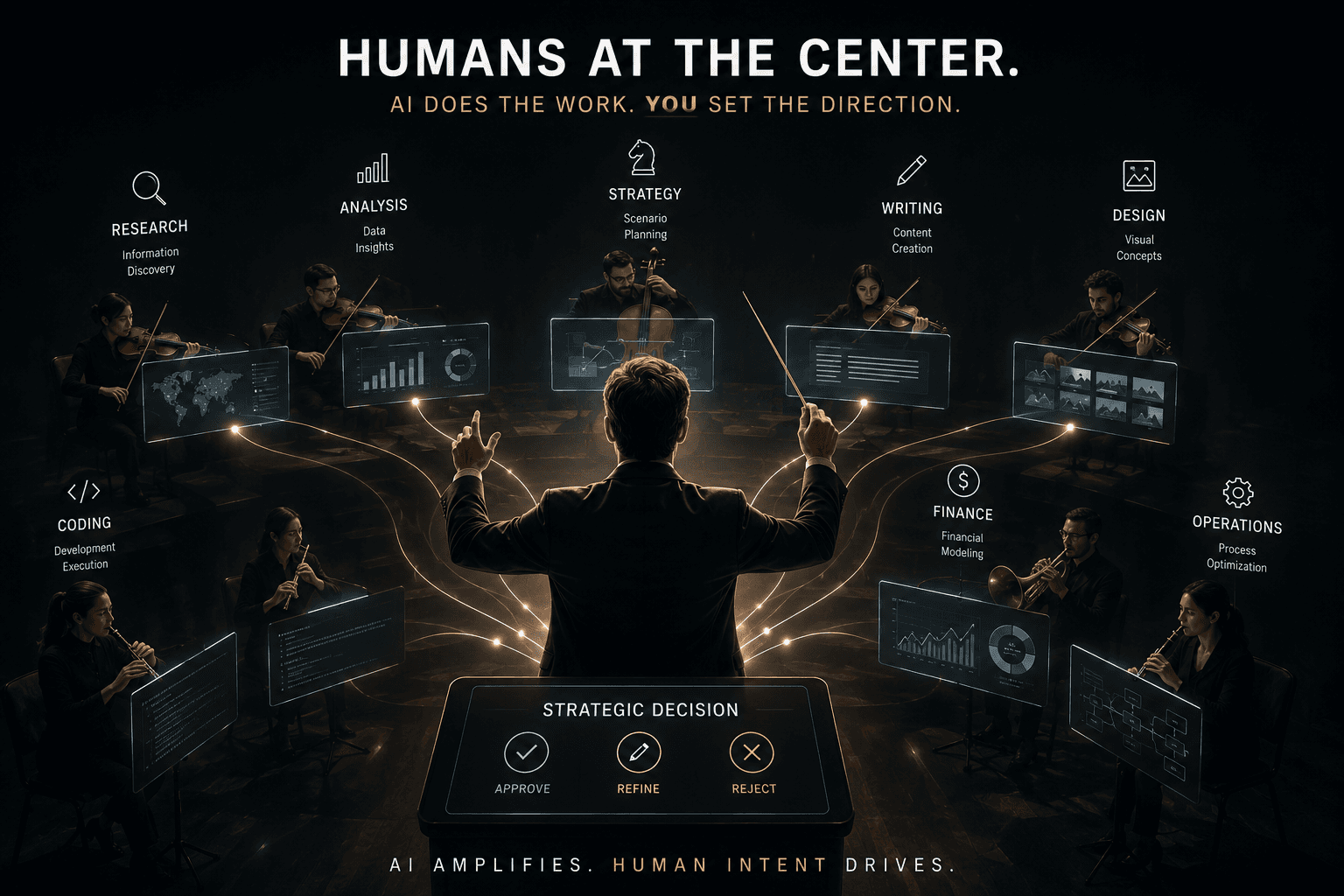
From human in the loop to human at the center. Humans define purpose. AI executes possibilities.
From speed to absorptive capacity. Winning organizations won’t move the fastest. They’ll integrate change without breaking their people.
Organizations that build human capability alongside AI won’t just adapt to the future. They will set its standards.
How to use AI without turning humans into the tool
Train judgment, not dependency. Require visible human thinking in AI outputs. Protect authorship and identity. Build cognitive fitness the way we once built physical fitness.
These are not soft practices. They are competitive infrastructure.
The moment we are actually in
AI removes the monopoly humans once had on cognitive execution. That creates two possible futures: a crisis of worth, or liberation from measuring worth through productivity. Which one emerges depends on what we choose to reward.
AI will scale whatever system we build around it. So the real question is not whether AI changes work. It is whether we finally redesign work around humans instead of forcing humans to fit work.
Closing
This is not the end of human value. It is the first moment we have the opportunity to define it deliberately.
Human-centered AI is not simply a safety principle. It is an economic strategy. Because the organizations and societies that succeed won’t be the ones replacing humans. They will be the ones elevating them.
About