

Mia Editorial Team

The AI transformation is not gender-neutral. The data is consistent and concerning: women are underrepresented in AI as builders, underrepresented as leaders, and more exposed to displacement as users. What happens in the next few years will determine whether AI becomes a force for greater equity or one that entrenches existing gaps.
Where the gap stands today
Only 12% of AI researchers globally are women (WomenTech Network, 2026). Women make up approximately 28% of the AI-related workforce, a figure that has grown by only 4 percentage points since 2016 (ILO, 2026). In STEM C-suite roles, representation drops to 12.2% (WEF, as cited by Change in Content, 2026).
In Europe, women's representation in tech roles has fallen from 22% in 2023 to 19% in 2026, with many AI-driven layoffs concentrated in roles disproportionately held by women (McKinsey, as cited by WEF, 2026). In low- and middle-income countries, women are 7% less likely to own a phone and 19% less likely to have access to mobile internet, compounding the access gap with a connectivity gap (GSMA, as cited by WEF, 2026).
The adoption gap reinforces the representation gap. Only 47% of women are using generative AI tools at work monthly or more, compared to 63% of young men (University of Phoenix, as cited by Recruiting Connection, 2026). A 16% confidence gap in AI skills exists across the general workforce (Recruiting Connection, 2026). And 41% of women are more likely than men to worry that colleagues will perceive them as less capable if they use AI, a social friction that has no equivalent in the data for men (SurveyMonkey, as cited by Recruiting Connection, 2026).
The opportunity hidden inside the gap
The same data that describes the problem also points toward the opportunity.
Women in senior technical roles are outpacing their male counterparts in generative AI adoption by an average of 14 percentage points (BCG, as cited by Recruiting Connection, 2026). The share of women listing AI engineering skills in their professional profiles rose from 23.5% in 2018 to 29.4% in 2025, and the gap narrowed in all but one of 75 countries surveyed (LinkedIn, as cited by WEF, 2025). When women have structured access to AI skills development, they close the adoption gap rapidly.

The ILO's March 2026 report makes the structural point clearly: when women are missing from AI-related jobs and decision-making roles, they are less likely to benefit from new employment opportunities and skills development. The gap compounds itself. Early exclusion from AI capability building leads to underrepresentation in AI roles, which leads to AI systems shaped without women's perspectives, which leads to tools that serve women less effectively.
What closing the gap requires
The WEF's Global Gender Gap Report 2025 found that 68.8% of the global gender gap is now closed, the fastest improvement since before the pandemic. Yet at the current pace, full parity will take an estimated 123 years (WEF, 2025). AI presents both an acceleration opportunity and an acceleration risk.
Three conditions consistently appear in organizations and initiatives that are closing the AI gender gap in practice.
Structured AI upskilling designed specifically for women's participation.
Generic corporate AI training programs tend to replicate existing participation patterns.
Programs built around women's specific contexts, schedules, and confidence barriers reach a different population and produce different outcomes.
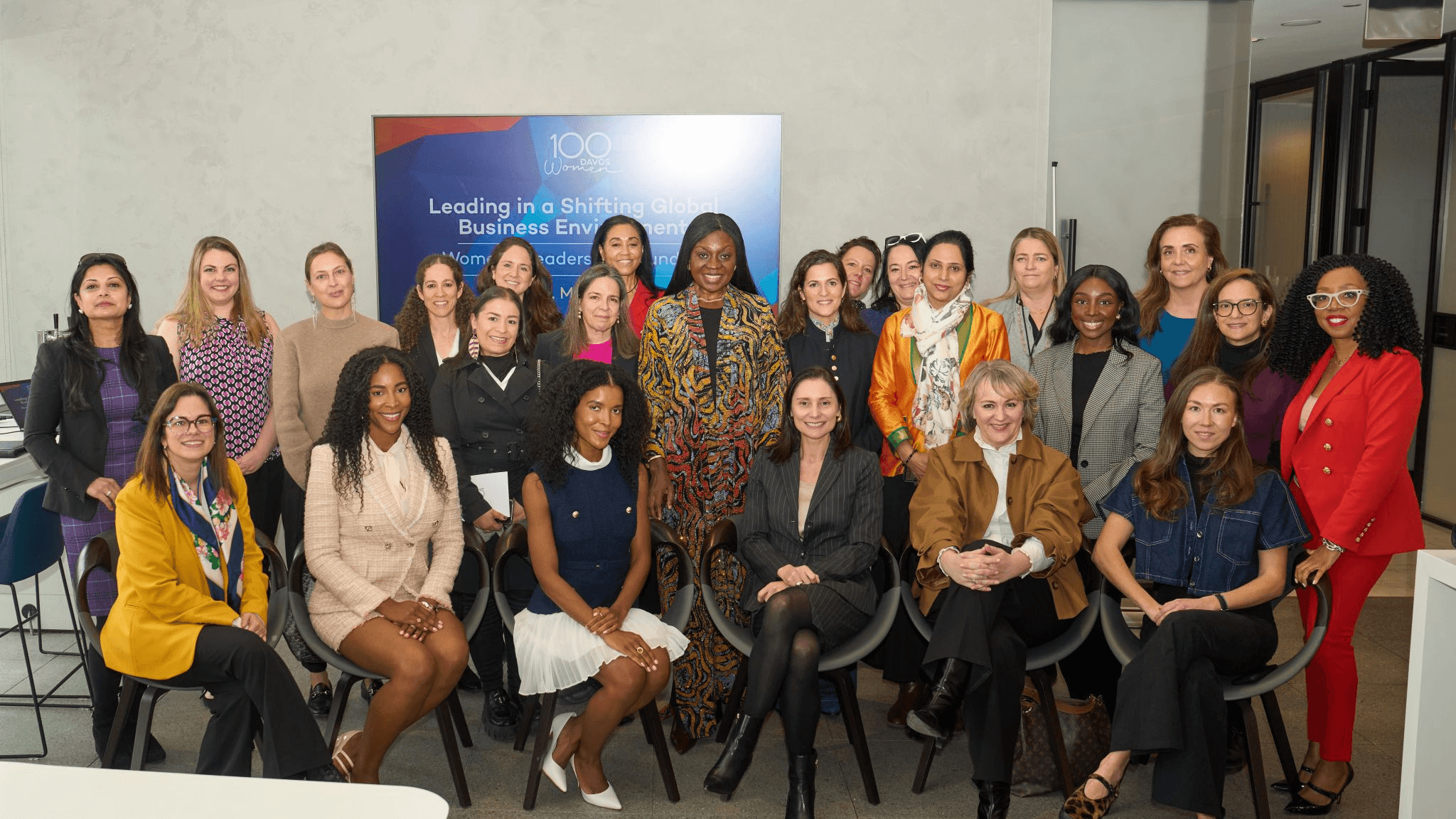
Above:
Mia AI CEO collaborating with the 100 Women @ Davos collective during the 2025 Davos World Economic Forum
Access without barriers. Mia AI was built on this principle:
free, global, human-first AI learning that does not require institutional affiliation, technical background, or geographic proximity to AI education resources.
Each session we run reinforces what we see consistently:
when access barriers are removed, women's engagement with AI capability building is immediate and deep.
Representation in AI design and leadership is crucial, not just as users.
The window to get this right is open, and our impact starts through educating women, empowering them to BE in the right rooms to make a difference.
Sources
International Labour Organization (ILO). (2026, March 5). New ILO data confirm women face higher workplace risks from generative AI than men. ILO. https://www.ilo.org/resource/news/new-ilo-data-confirm-women-face-higher-workplace-risks-generative-ai-men
Recruiting Connection. (2026, April 30). Women in tech: Statistics, challenges, retention strategies. https://recruitingconnection.org/blog/women-in-tech-statistics-challenges-retention-strategies/
WomenTech Network. (2026, April 14). Women in tech stats 2026. WomenTech Network. https://www.womentech.net/en-bg/women-in-tech-stats
World Economic Forum. (2026, March 20). Is AI changing the path to gender parity? Jobs and skills trends. WEF. https://www.weforum.org/stories/2026/03/ai-gender-parity-womens-history-month-jobs/
World Economic Forum. (2025, March 26). Can AI fix the gender gap in STEM? WEF. https://www.weforum.org/stories/2025/03/ai-stem-women-gender-gap/
About


How AI Is Expanding Access to Education Globally