


Mia Editorial Team

AI is simultaneously one of the largest new sources of energy demand on earth and one of the most powerful tools available for understanding and managing climate change. Those two facts are not contradictory. They are the essential tension that every organization serious about sustainability needs to understand.

What AI is actually doing for climate
The real-world applications are concrete and growing.
Google DeepMind's GraphCast model produces a 10-day global weather forecast in under one minute, enabling faster extreme-weather warnings across the globe (ExplainX, 2026). Google also used DeepMind AI to predict wind farm output up to 36 hours in advance, increasing the value of wind energy by 20% in tests by allowing grid operators to integrate renewable energy more safely and efficiently (The Insight RR, 2026).
A 2025 research study found that AI could reduce global emissions by 3.2 to 5.4 billion tonnes of CO2-equivalent annually by 2035 through applications in energy optimization, precision agriculture, emissions monitoring, and renewable grid management (The Sustainable Agency, 2026). AlphaFold's protein structure predictions are accelerating materials discovery for next-generation battery and solar cell development. AI-powered precision agriculture is reducing fertilizer and water use at scale across multiple continents.
These are not speculative benefits. They are documented, measurable outcomes from systems already in deployment.
The energy cost of AI itself
The same technology generating those climate benefits is also a fast-growing energy consumer.
Data centers globally are projected to consume approximately 1,000 TWh of electricity annually by 2026, with AI accounting for 10 to 28% of that data center energy demand (International AI Safety Report, 2026). Microsoft's data centers consumed 6.4 million cubic meters of water in a single year for cooling. Amazon's emissions surged 6% in 2024 partly due to AI-related data center expansion (The Sustainable Agency, 2026). In Ireland, data centers driven in part by AI growth could account for nearly 35% of the country's total energy use by 2026 (UNEP, 2025).
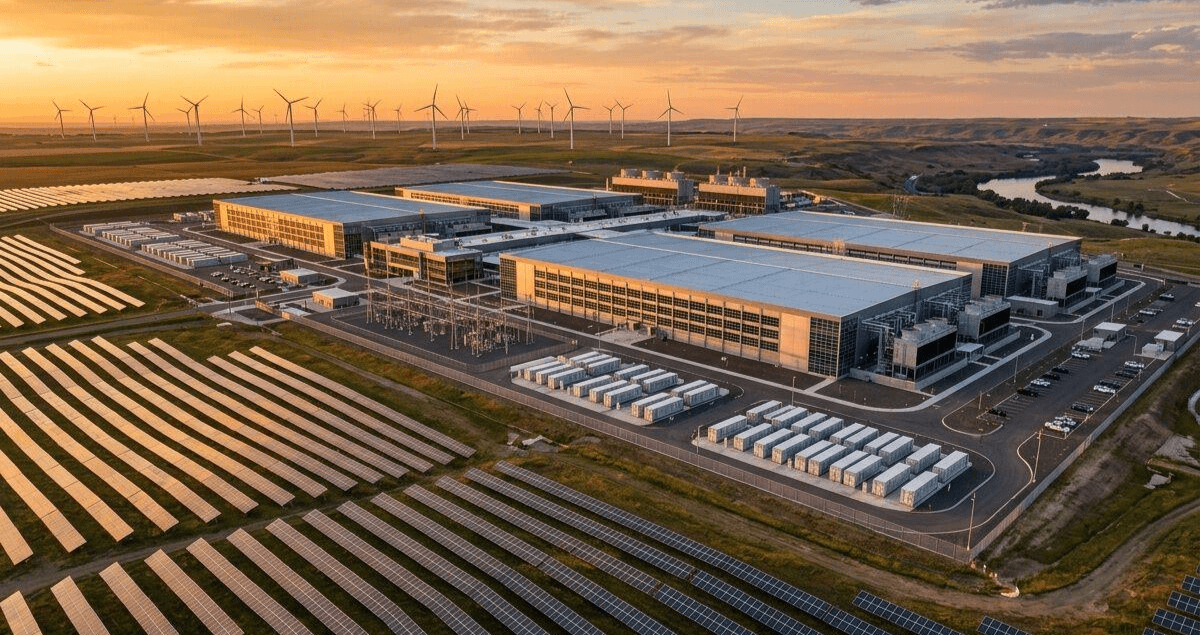
The carbon math is complicated further by what researchers call enabled emissions. A February 2026 report found that AI-driven productivity gains in fossil fuel extraction could increase net global emissions by 0.47 to 1.8 gigatonnes of CO2 annually, between 1.2% and 4.8% of global energy-related emissions, because the same AI tools that optimize renewables also make fossil fuel production faster and cheaper (npj Climate Action, 2026, as cited by The Sustainable Agency, 2026).
The same report found that 74% of industry claims about AI's climate benefits were unproven, and could not identify a single case where consumer generative AI systems were delivering material, verifiable, and substantial emissions cuts (Beyond Fossil Fuels, February 2026, as cited by Greenpeace International, 2026).
What this means for organizations with sustainability commitments
For organizations that have made climate commitments and are also deploying AI, the tension is not hypothetical. It is showing up in emissions reports.
The IEA's 2025 Energy and AI report identified the core question: AI applications in the energy sector could help reduce emissions by unlocking new optimizations and efficiencies, but only if those applications receive the right investment and the right governance. The same technology deployed differently produces very different climate outcomes.
Three practical implications for organizations navigating this tension:
AI deployment decisions are now sustainability decisions. The location of data centers, the energy sources powering them, and the use cases being prioritized all have measurable climate implications. Organizations with net-zero commitments need AI governance frameworks that include environmental accountability alongside data security and ethical use.

The strongest AI climate applications are in specific domains. Energy grid optimization, climate modeling, precision agriculture, and materials discovery have clear, verifiable climate benefits. Deploying AI in these contexts with the right human oversight produces real emissions reductions. Deploying generative AI broadly and claiming climate benefits from vague future efficiencies does not.
Human judgment remains the critical variable. AI can model climate scenarios, optimize energy flows, and predict extreme weather events. It cannot decide which emissions reductions to prioritize, how to navigate political trade-offs in energy transition, or how to balance short-term economic pressures against long-term climate targets. Those decisions require the ethical judgment, systems thinking, and leadership capability that no model can replicate.
This is precisely the dimension that most AI training programs overlook. At Mia AI, developing that human layer — the critical thinking, ethical reasoning, and applied judgment to direct AI toward responsible outcomes — is not a module at the end of a program. It is the foundation of every capability-building engagement we run.
Sources
ExplainX AI. (2026, June 26). AI and climate change 2026: Energy footprint vs. climate solutions. ExplainX. https://www.explainx.ai/blog/ai-climate-change-energy-sustainability-2026
Greenpeace International. (2026). The energy and environmental impact of AI and how it undermines democracy. Greenpeace. https://www.greenpeace.org/international/story/82486/ai-energy-environment-democracy/
International AI Safety Report. (2026). Section 2.3.4: Risks to the environment. arXiv. https://arxiv.org/pdf/2501.17805
International Energy Agency (IEA). (2025). Energy and AI: AI and climate change. IEA. https://www.iea.org/reports/energy-and-ai/ai-and-climate-change
The Insight RR. (2026, May 15). Using AI to tackle climate change: Real-world applications and impact. The Insight RR. https://theinsightrr.com/using-ai-to-tackle-climate-change-real-world-applications-and-impact
The Sustainable Agency. (2026). Environmental impact of generative AI: Stats and facts for 2026. The Sustainable Agency. https://thesustainableagency.com/blog/environmental-impact-of-generative-ai/
United Nations Environment Programme (UNEP). (2025). AI has an environmental problem. Here's what the world can do about that. UNEP. https://www.unep.org/news-and-stories/story/ai-has-environmental-problem-heres-what-world-can-do-about
About


Women and AI: Building Capability Before the Gap Becomes Permanent

How AI Is Expanding Access to Education Globally