


Mia Editorial Team

86% of students worldwide now use AI tools as part of their learning process (Quantumrun, 2026). The global AI in education market reached $7.57 billion in 2025 and is projected to exceed $112 billion by 2034, growing at 36% annually (Faculty Focus, 2026).
Those numbers describe adoption at scale. What they do not fully capture is the equity question underneath them: who is benefiting, and who is being left behind.
The promise: AI as a great equalizer in education
The most compelling case for AI in education is not efficiency. It is access. AI-powered tutoring systems, adaptive learning platforms, and real-time language instruction tools are reaching students in contexts where qualified teachers are scarce and educational infrastructure is limited.
South Korea's rollout of AI-powered digital textbooks for math, English, and computing, backed by $70 million in digital infrastructure and $760 million in teacher training, demonstrated what national-scale AI education deployment looks like when governments invest seriously in both the technology and the human capability to use it (DevelopmentAid, 2025). From September 2025, China integrated AI into its national curriculum as a compulsory subject for all students from primary school onward. Australia approved a National Framework for Generative AI in Schools and launched a phased rollout in 2024.

The outcomes data is encouraging where deployment is well-structured. Students using an enhanced AI tutoring system achieved 127% improvement in learning outcomes, compared to 48% with a standard AI chatbot (Passive Secrets, 2026). University students using AI tools scored approximately 10% higher on assessments than non-users.
The gap: access does not equal capability
The adoption numbers conceal a structural problem that organizations working in education and workforce development cannot afford to ignore.
Nearly 60% of educators and students say they have received no AI training, despite rising adoption (Passive Secrets, 2026). A significant perception gap exists alongside that: 76% of institutional leaders believe their users are trained on AI tools, while 45% of educators and 52% of students report receiving zero training. Tools are being deployed. The capability to use them effectively is not keeping pace.
This is the same gap that exists in enterprise AI adoption, and the consequences are similar. Access without capability produces surface-level usage without meaningful learning outcomes.
The infrastructure barrier in developing countries
The most substantive recent assessment of AI's potential in global education comes from the World Bank's World Development Report 2026, published August 4, 2026, and described as the first comprehensive assessment of AI's implications for developing countries.
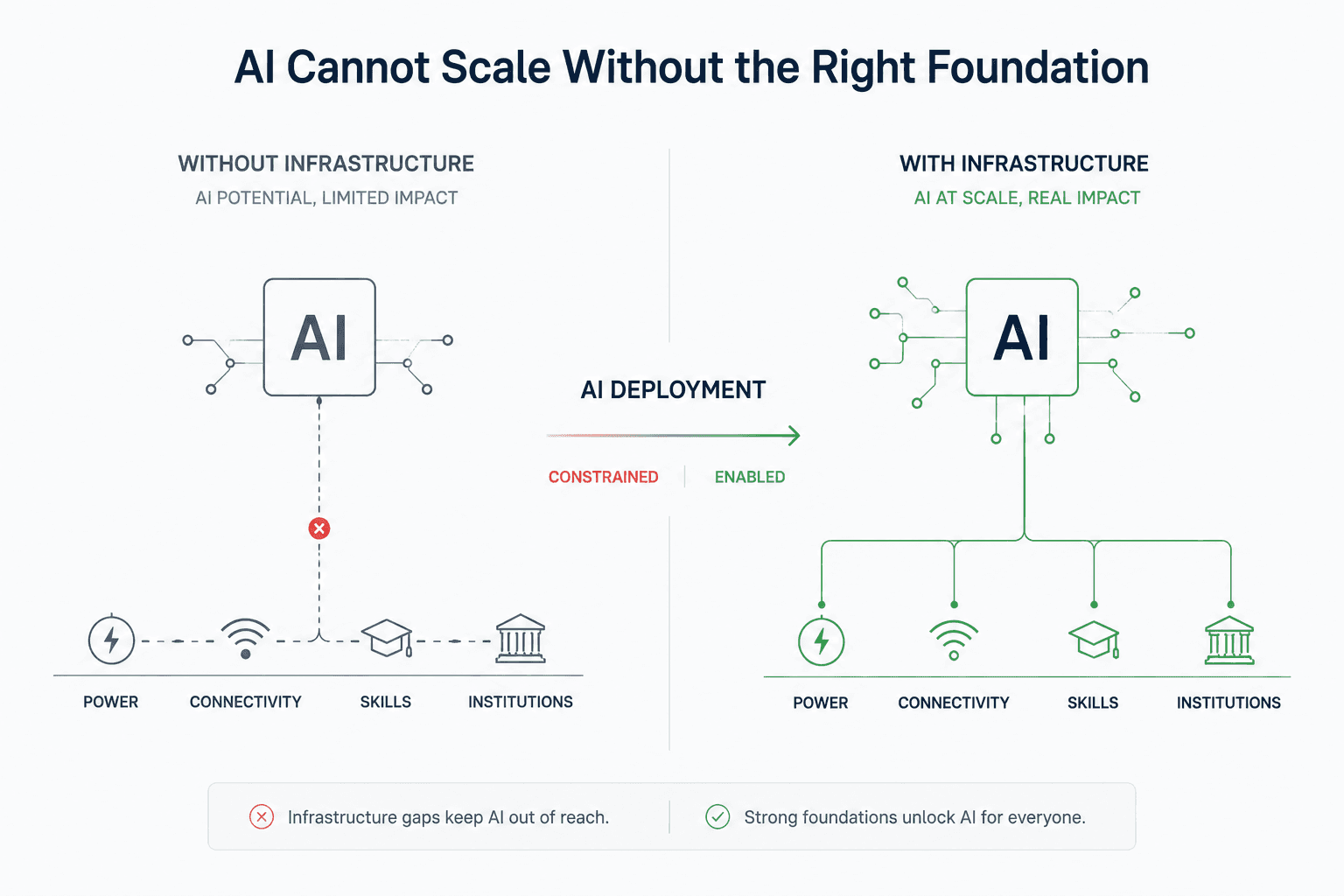
The report's conclusion is direct: AI could help developing countries improve education, healthcare, and public services within a decade, but only if governments close gaps in electricity, internet access, skills, and institutions first (World Bank, 2026). In Sub-Saharan Africa, nearly one-third of rural schools still lack reliable electricity. More than two-thirds lack dependable internet access. Without that infrastructure foundation, AI in education cannot reach most students regardless of how good the technology becomes.
Gaurav Nayyar, Director of the World Development Report 2026, framed the urgency clearly: "The window to get this right is narrow." Countries building power, connectivity, skills, and institutions now will be positioned to adopt and adapt AI for their populations. Those that do not will find the gap widening rather than narrowing.
What this means for organizations
For organizations operating in education, workforce development, or corporate AI training, the global AI education picture surfaces three consistent lessons.
Adoption without training creates a false picture of readiness. The 76%/45% perception gap in education mirrors what workforce research consistently finds in enterprise AI: leaders overestimate how prepared their people actually are.
Infrastructure precedes capability. Whether it is electricity access in Sub-Saharan Africa or governance frameworks in enterprise organizations, the foundational conditions for effective AI use must be in place before the technology can deliver on its potential.
The equity dimension is not optional. AI that reaches only well-resourced students or well-resourced organizations does not expand access. It concentrates advantage. The organizations — and the countries — that take this seriously are the ones building AI education strategies that address the capability gap alongside the access gap.
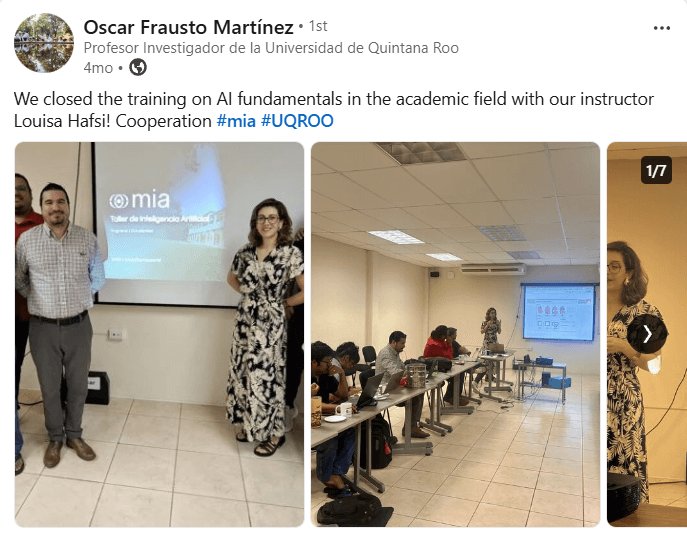
Above image:
The Mia Team hosting a free AI Upskilling workshop for Master's Degree & PhD Students in the University Of Quintanaroo, Campus Cozumel, Mexico.
For Mia AI, the global AI education picture reinforces a conviction that runs through everything we build: access to AI learning should not be determined by geography, budget, or institutional prestige.
That is why the Mia AI Team regularly partners with Universities & NGOs to address this gap and is commited yo making AI literacy genuinely accessible.
Sources
DevelopmentAid. (2025, April 27). AI goes to school: The global AI education race, opportunities and perils. DevelopmentAid. https://www.developmentaid.org/news-stream/post/194647/ai-transforming-education
Faculty Focus. (2026, January 21). Designing the 2026 classroom: Emerging learning trends in an AI-powered education system. Faculty Focus. https://www.facultyfocus.com/articles/teaching-with-technology-articles/designing-the-2026-classroom-emerging-learning-trends-in-an-ai-powered-education-system/
Passive Secrets. (2026, January 27). 75+ AI in education statistics (2026): New trends and impact. Passive Secrets. https://passivesecrets.com/ai-in-education-statistics/
Quantumrun Foresight. (2026, March 4). Technology in education statistics 2026. Quantumrun. https://www.quantumrun.com/consulting/technology-in-education/
World Bank Group. (2026, August 4). World Development Report 2026: The promise of artificial intelligence (as reported by WINS Solutions). https://www.winssolutions.org/world-bank-ai-education-developing-countries/
About