

Why AI Training Is Failing in Most Organizations

Here’s a number worth sitting with: according to DataCamp’s 2026 State of Data & AI Literacy Report, 82% of organizations already provide some form of AI training for employees. Yet 59% of leaders still report a significant AI skills gap.
More training. Same gap.

According to BCG’s 2025, only 5% of organizations have achieved substantial financial gains from AI. The other 95% have deployed the tools, delivered the training, and are still waiting for results.
The problem is not effort. It is design.
The Real Barrier Is Not the Technology
When AI initiatives stall, organizations look at the tools first. Wrong model? Bad infrastructure? Too fast a rollout?
MIT’s Project NANDA studied more than 300 enterprise AI deployments in 2025. The core issue, across organizations that saw zero measurable return, was almost never the model. It was what MIT calls the “learning gap”: the absence of structured capability-building for the people expected to use AI every day.
BCG’s analysis, across hundreds of client engagements, puts a number on it. Of all the value AI can create inside an organization, 10% comes from the algorithms. 20% from technology infrastructure. 70% from people, processes, and change management.
Most organizations are investing almost exactly backwards.
Four Reasons Corporate AI Training Is Not Working
1. It is disconnected from real work
Most employee AI training still follows the same format: what AI is, how large language models work, a few prompting exercises in a sandbox. Employees complete the module, get a certificate, and return to their desk with no idea how any of it applies to their actual role.
IDC is direct on this point: AI upskilling fails when it is not connected to employees’ day-to-day tasks. Integrating AI into human workflows requires practice in context, not generic exercises. IDC also found that only 36% of organizations mandate AI awareness training at all.
2. Passive learning is not capability
Watching a video builds familiarity. It does not build skill. DataCamp’s 2026 report found that 24% of leaders whose organizations offer AI training say there are not enough hands-on projects or labs. Employees are walking through concepts they cannot yet apply.

Josh Bersin, CEO of The Josh Bersin Company, frames this clearly in Deloitte’s 2026 Global Human Capital Trends Report: “Our skills challenge at work is not one of ‘learning’ or ‘training’. Rather it’s a problem of dynamically sharing information, enabling people to explore, question, and apply new ideas. The traditional pedagogical paradigm of ‘training’ is holding us back.”
3. Programs are fragmented and unmeasured
In most organizations, IT deploys the tools and Learning & Development (L&D) runs the training. The two functions rarely coordinate. IDC found that 40% of IT leaders struggle with fragmented, inconsistent skills development across their organizations. Only 35% of enterprise leaders say their organization has a mature, organization-wide AI upskilling program, according to DataCamp’s 2026 report.
4. Formal programs are shrinking while demand grows
LinkedIn’s 2026 Workplace Learning Report found that only 26% of organizations now offer formal AI upskilling programs, down from 35% the previous year. Meanwhile, Docebo’s 2026 AI Readiness Gap Report found that 1 in 5 employees has received no AI training at all. The gap is widening at exactly the wrong moment.
What the Gap Actually Costs
This is not just a learning problem. It is a business problem.
IDC projects that sustained AI skills shortages will cost the global economy $5.5 trillion in lost market performance, with more than 90% of global enterprises expected to face critical shortages by 2026.
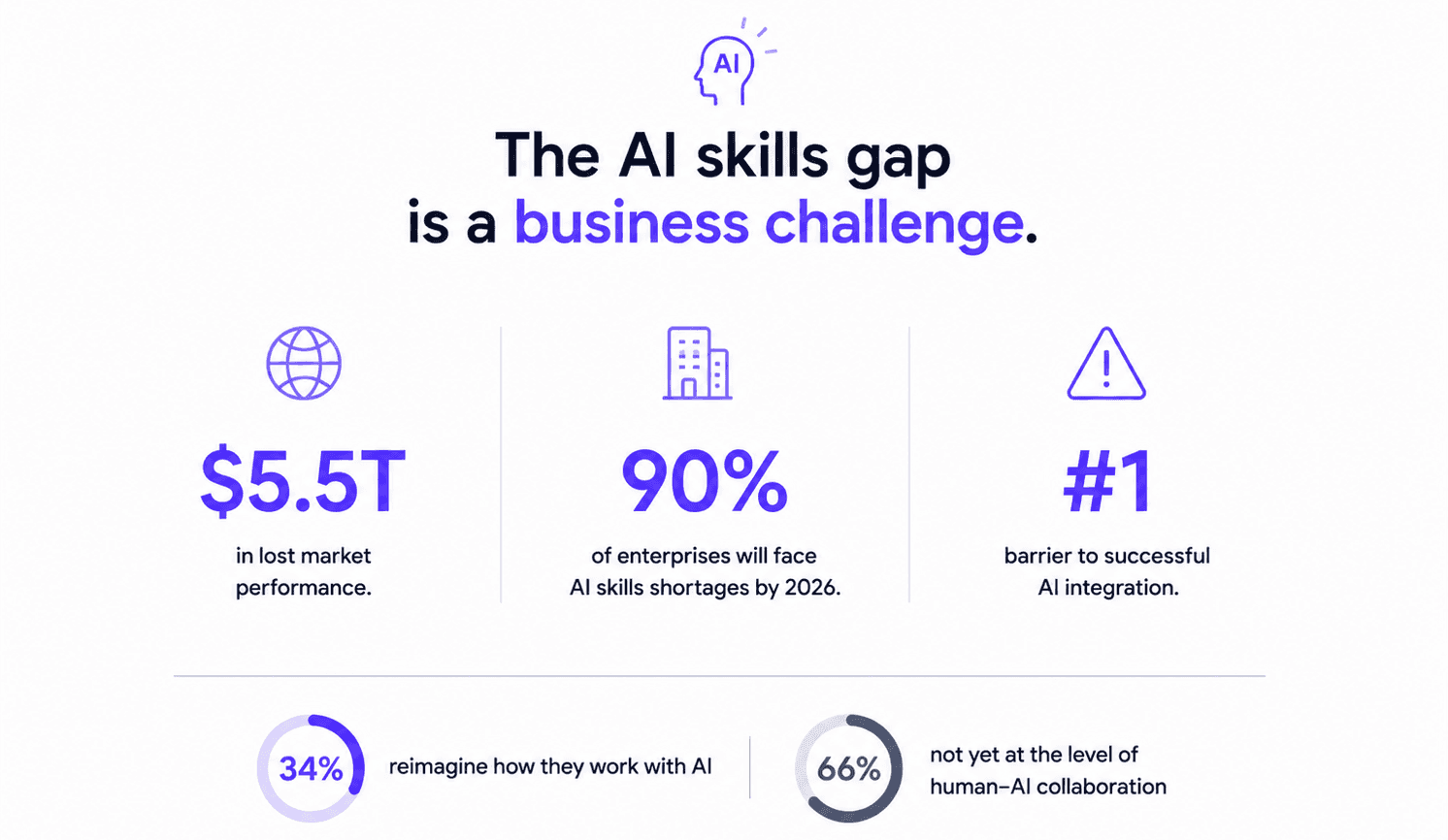
Deloitte’s 2026 State of AI in the Enterprise, based on a survey of 3,235 senior leaders, identifies the AI skills gap as the single biggest barrier to AI integration. Only 34% of organizations are genuinely reimagining how their business operates with AI. The majority are using AI for efficiency gains but have not reached the level of human-AI collaboration that drives real transformation.
What Effective AI Upskilling Actually Looks Like
The organizations generating real returns from AI share a clear pattern. DataCamp’s 2026 report finds that companies with a mature, enterprise-wide AI and data literacy program are almost twice as likely to report significant positive AI ROI. The same report shows AI training delivers an average return of $3.70 per dollar invested, rising to $10.30 for organizations with the most structured programs.
Across successful organizations, including those working with platforms like Mia AI, effective AI training programs share the same characteristics:
• Built around specific business functions and real use cases, not generic AI literacy modules.
• Applied practice in actual workflows, not simulated environments.
• Full spectrum development, from foundational AI literacy through to transformation.
• Measurement of capability development, not course completion.
• Continuous reinforcement, not one-off training events.
Effective AI adoption is not just about teaching employees how to use tools. It is about helping them work alongside AI effectively, evaluating outputs critically, exercising judgment when AI gets things wrong, and applying ethical reasoning to decisions AI cannot make on its own.
The Question Is Not Whether to Train. It Is How.
BCG’s analysis is clear: 70% of AI value comes from people and processes, not algorithms. That means AI upskilling is not a supporting initiative. It is one of the most important strategic investments an organization can make.
But according to Docebo’s 2026 AI Readiness Gap Report, 85% of employees say the training they received does not help them use AI in their actual role. The programs exist. The capability is not developing.
The organizations that will close the gap are not the ones with the largest training budgets. They are the ones that stop asking:
“How many employees completed the training?”
And start asking: “How many employees can now do something they could not do before?”
That shift is where AI workforce readiness begins. And where lasting business value follows.
Sources
BCG. (2025). Build for the future x AI 2025 global study. Boston Consulting Group. https://www.bcg.com/publications/2025/build-for-the-future-x-ai
BCG. (2025). Strategies to tackle the AI skills gap. Boston Consulting Group. https://www.bcg.com/publications/2025/strategies-to-tackle-the-ai-skills-gap
DataCamp. (2026). 2026 state of data & AI literacy report (YouGov survey, N = 500+ enterprise leaders, US & UK). DataCamp. https://www.datacamp.com/resources/whitepapers/2026-state-of-data-ai-literacy-report
Deloitte. (2026). State of AI in the enterprise 2026 (Survey of 3,235 senior leaders, August–September 2025). Deloitte Insights. https://www2.deloitte.com/us/en/insights/focus/cognitive-technologies/state-of-ai-and-intelligent-automation-in-business-survey.html
Deloitte & The Josh Bersin Company. (2026). Global human capital trends 2026. Deloitte Insights. https://www2.deloitte.com/us/en/insights/focus/human-capital-trends.html
Docebo. (2026, April). The AI readiness gap: 2026 enterprise learning wake up call (Centiment survey, N = 2,000, across US, UK, Canada, France, Germany, Italy). Docebo. https://www.docebo.com/resource/ai-readiness-gap-report/
IDC & Workera. (2025–2026). The $5.5 trillion skills gap: AI workforce readiness report. IDC. https://workera.ai/resources/idc-report-ai-workforce-readiness/
LinkedIn. (2026). LinkedIn workplace learning report 2026. LinkedIn Learning. https://learning.linkedin.com/resources/workplace-learning-report
MIT Project NANDA. (2025, July). The GenAI divide: State of AI in business 2025 (Analysis of 300+ enterprise AI deployments). MIT. https://nanda.mit.edu/
World Economic Forum. (2025). Future of jobs report 2025. WEF. https://www.weforum.org/publications/the-future-of-jobs-report-2025/