
Why AI Adoption Is Outpacing Workforce Readiness

Artificial Intelligence has moved beyond experimentation. Employees are already using AI tools, organizations are investing heavily in AI initiatives, and leaders increasingly recognize AI as a strategic priority. Yet despite rapid adoption, many organizations struggle to translate AI investments into meaningful business impact. The challenge is no longer access to AI technology. The challenge is workforce readiness.
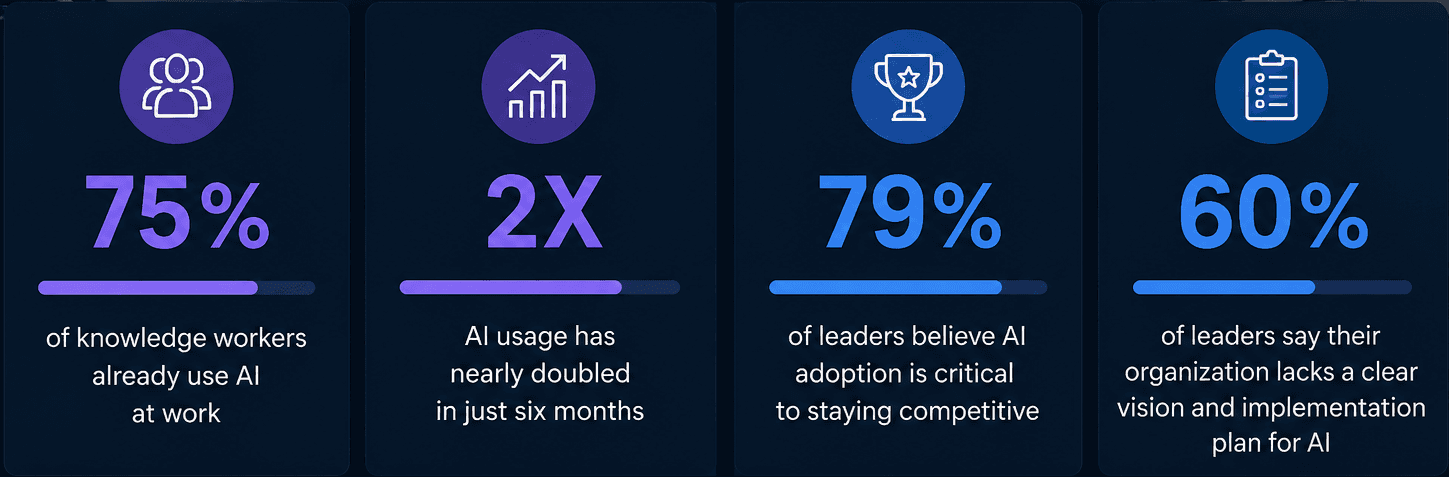
According to Microsoft's 2024 Work Trend Index, based on a survey of 31,000 workers across 31 countries, 75% of knowledge workers already use AI at work, and AI usage has nearly doubled in just six months. At the same time, 79% of leaders believe AI adoption is critical to staying competitive, yet 60% say their organization lacks a clear vision and implementation plan for AI.
This disconnect reveals a critical reality: AI adoption is moving faster than organizational readiness.
The AI Skills Gap Is Growing
One of the most significant barriers to successful AI transformation is not technology—it is capability.
While AI tools continue to become more powerful and accessible, organizations face increasing challenges in developing the skills needed to use them effectively.
Research from Gartner highlights the scale of this challenge. Demand for AI-related skills is growing rapidly across industries, with AI-related job requirements increasing dramatically in recent years. Gartner's analysis suggests that organizations cannot rely solely on hiring new talent; internal upskilling has become a business necessity.
At the same time, employees are not waiting for formal training programs.
Microsoft reports that 78% of AI users are bringing their own AI tools into the workplace. Employees are experimenting with generative AI independently, often without organizational guidance, governance, or structured training.
This creates a growing gap between individual adoption and organizational capability.
Why Traditional Corporate Training Falls Short
Many organizations respond to AI by offering a webinar, a one-day workshop, or a general awareness session. While these initiatives can raise awareness, they rarely create lasting behavioral change. AI capability is not built through passive learning alone. Employees need opportunities to apply AI in real business contexts, experiment safely, receive feedback, and continuously develop their skills.
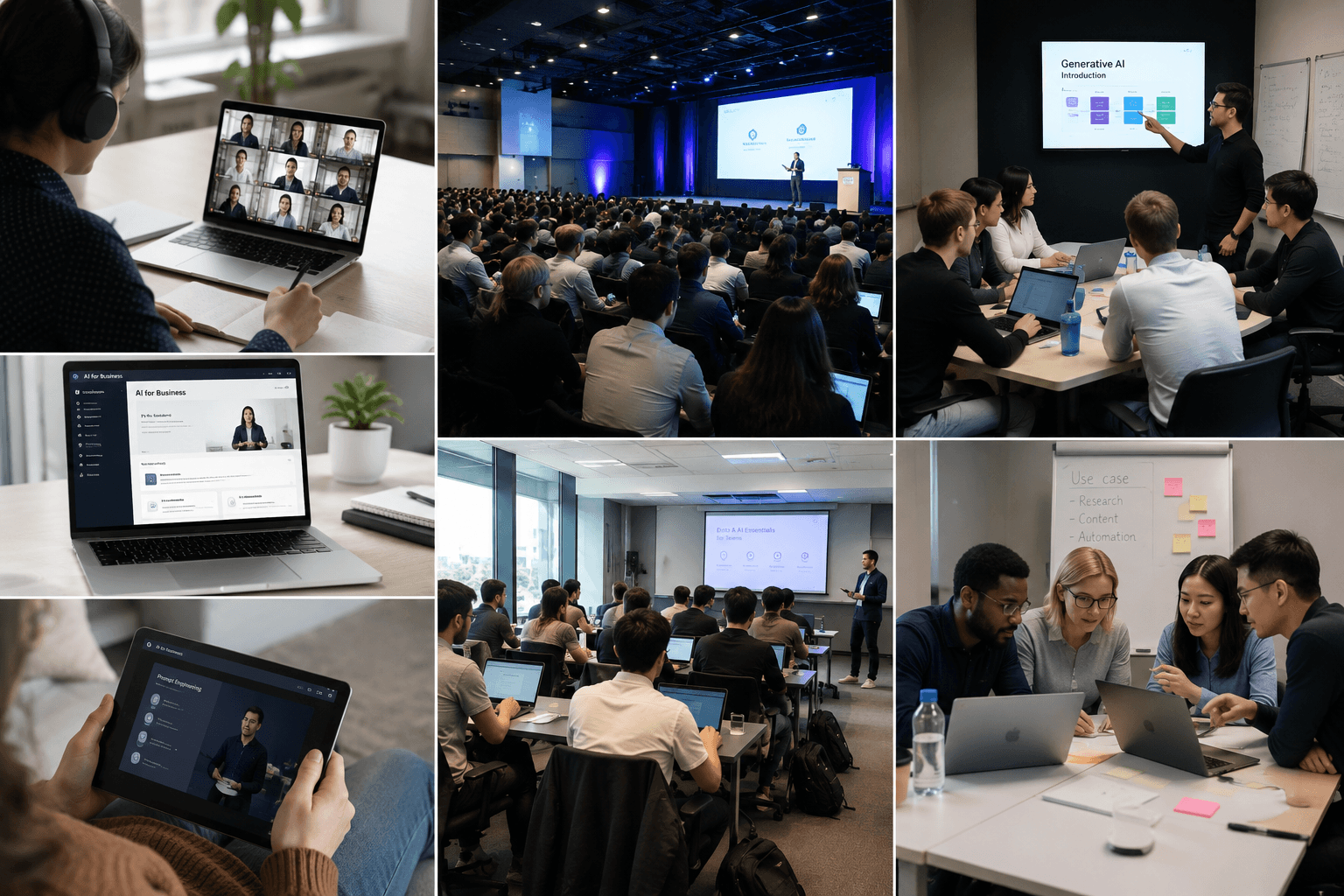
Organizations often assume that exposure leads to proficiency. In reality, effective AI adoption requires a structured learning journey.
Without practical application, employees may understand what AI is, but struggle to identify where and how it creates value in their daily work.
At Mia AI, we view AI readiness as a structured progression — from foundational awareness through to sustainable business transformation.
What Effective AI Upskilling Looks Like
Successful AI capability-building programs share several common characteristics:
Learning by doing rather than passive consumption.
Practical use cases aligned with specific business functions.
Interactive workshops that encourage experimentation.
Continuous reinforcement rather than one-off training sessions.
Measurement of capability development over time.
This approach recognizes an important reality: AI adoption is as much a people challenge as it is a technology challenge.
Organizations that focus exclusively on tools often overlook the human capabilities required to create value from those tools.
These are the principles that define how Mia AI builds every AI upskilling program — function-specific, applied to real workflows, and designed to build capability that lasts.
Human Skills Matter More Than Ever
Contrary to common assumptions, AI is not reducing the importance of human skills.
Research from Cisco's AI Workforce Consortium found that 78% of ICT roles now include AI-related technical competencies, while human capabilities such as communication, leadership, critical thinking, ethical judgment, and collaboration are becoming even more important.

As AI becomes integrated into everyday work, competitive advantage increasingly depends on an organization's ability to combine technical capability with human judgment.
The future of work is not AI versus humans.
It is humans working effectively with AI.
Measure Readiness Before Scaling AI Investments
Before investing further in AI technologies, organizations should understand their current level of workforce readiness.
Assessing readiness helps identify:
Existing capability gaps.
Training priorities.
Areas where AI can create the greatest impact.
Organizational barriers to adoption.
Organizations that measure readiness are better positioned to move beyond experimentation and achieve meaningful transformation.
Readiness should not be assumed. It should be assessed, developed, and continuously improved.
Conclusion
The AI conversation is changing. The question is no longer whether organizations should adopt AI. Most already have. The real question is whether their people are ready to use it effectively.
With 75% of employees already using AI, 78% bringing AI tools into their work independently, and leaders recognizing AI as a competitive necessity, workforce readiness has emerged as one of the most important challenges facing organizations today.
The organizations that succeed in the next phase of AI transformation will not necessarily be those with access to the most advanced technology.
They will be the ones that invest in building the human capabilities needed to turn AI potential into real business value.
That is the work Mia AI was built to support. If you want to understand where your organization stands today, start with a readiness assessment.
References
Cisco AI Workforce Consortium. (2025, September 16). ICT in motion: The next wave of AI integration. Cisco Systems. https://newsroom.cisco.com/c/r/newsroom/en/us/a/y2025/m09/ai-workforce-consortium-finds-78-of-ict-roles-now-include-ai-technical-skills-while-human-skills-gain-priority-for-responsible-tech-adoption.html
Gartner. (2024, October 3). Gartner says generative AI will require 80% of engineering workforce to upskill through 2027. https://www.gartner.com/en/newsroom/press-releases/2024-10-03-gartner-says-generative-ai-will-require-80-percent-of-engineering-workforce-to-upskill-through-2027
Microsoft & LinkedIn. (2024, May 8). AI at work is here. Now comes the hard part: 2024 Work Trend Index annual report. Microsoft. https://www.microsoft.com/en-us/worklab/work-trend-index/ai-at-work-is-here-now-comes-the-hard-part