

What Is AI Readiness and How Do You Measure It?

Most organizations think they know how AI-ready their workforce is. The reality? They usually don't.
On paper, everything looks promising. Learning & Development leaders are confident their teams have the AI skills they need. But when employees are actually assessed, a very different picture emerges. According to Workera (2026), while 85% of L&D leaders believe their workforce is AI-proficient, only 11% of employees can demonstrate the level of capability their leaders expected.
That disconnect is more than just an interesting statistic—it's where many AI transformation efforts quietly begin to stall.
Yes, AI adoption is happening at scale. EY (2025) reports that 88% of employees already use AI in their day-to-day work. But here's the catch: only 5% are using it in ways that truly transform how they work. For everyone else, AI remains a productivity booster rather than a business game changer. The result? Organizations leave as much as 40% of their potential productivity gains on the table.
This raises a much more important question than "Are people using AI?"

The real question is: Are they using it well enough to create measurable business value?
That's what AI readiness is really about. It goes far beyond adoption rates, training completion, or employee confidence. It means understanding whether people have the knowledge, skills, and judgment to integrate AI effectively into their work—and, most importantly, whether they can turn AI into better decisions, faster execution, and stronger business outcomes.
The good news is that AI readiness doesn't have to be based on assumptions. Unlike confidence surveys or learning dashboards, it can be measured objectively. And for organizations serious about scaling AI, that's where the real transformation begins.
What AI Readiness Actually Is
AI readiness is not a technology question. Access to AI tools, platform subscriptions, and awareness training are not readiness. Many organizations have all three and still struggle to generate measurable value.
AI readiness is an organization’s ability to deploy, operate, and continuously create value from AI — measured across its people, its processes, its governance, and its culture. Not just its infrastructure.
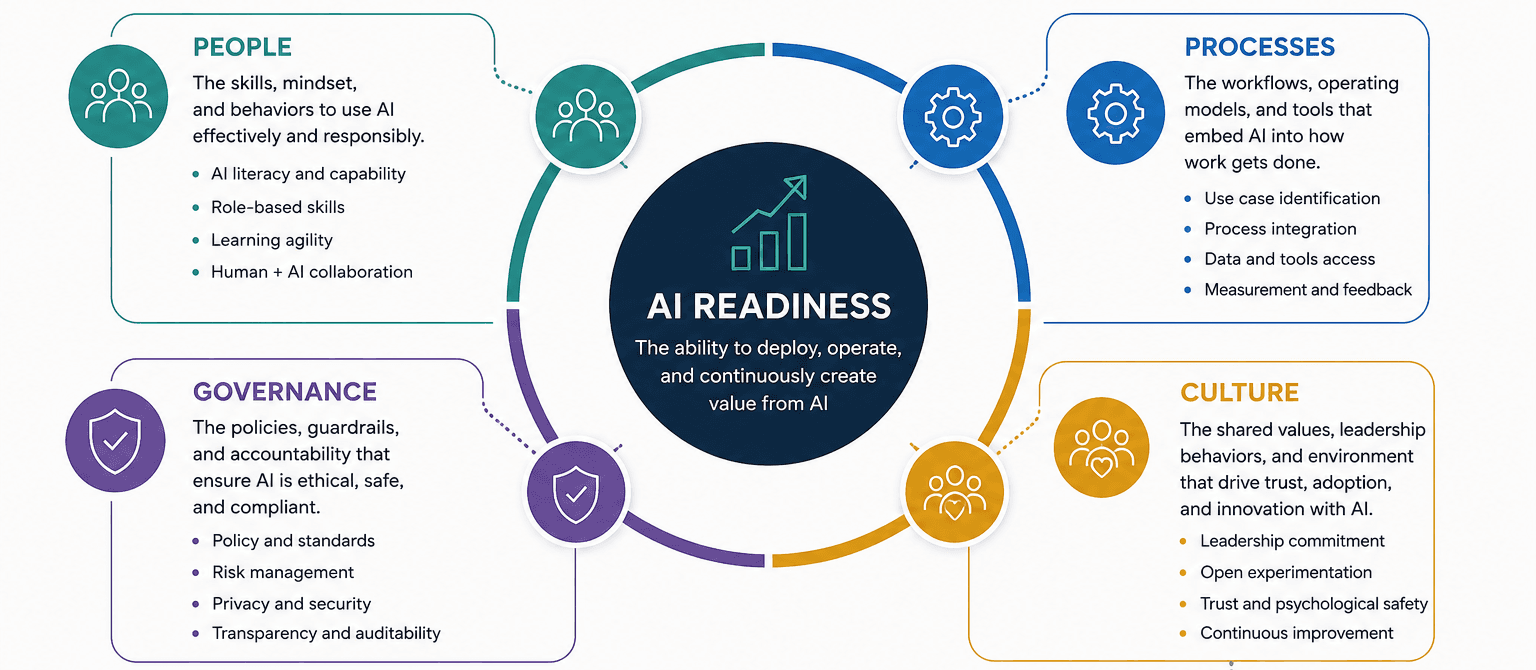
Most organizations measure the wrong things: course completions, tools deployed, login rates. These are operational inputs. They do not reveal whether employees can actually perform their work differently because of AI.
Usage is not readiness. Adoption is not capability. And capability is what creates business value.
Why Organizations Overestimate Where They Stand
The problem is structural. Most AI readiness assessments rely on self-reported data: how confident leaders feel, how employees rate their own proficiency, how many modules have been completed. These metrics are easy to collect. They consistently overstate actual readiness.

The ServiceNow 2025 Enterprise AI Maturity Index illustrates what happens when organizations move beyond self-assessment. The average enterprise AI maturity score dropped from 44/100 in 2024 to 35/100 in 2025 — not because organizations regressed, but because more honest measurement revealed how far most still have to go (ServiceNow, 2025). Fewer than 1% of organizations scored above 50. Among the highest performers, the average was still only 44.
The same report highlights a revealing contradiction: 55% of organizations have deployed more than 100 AI use cases, yet only 19% say those initiatives are generating meaningful business outcomes (ServiceNow, 2025). Only 29% strongly agree they have clear metrics to measure AI return on investment.
Deploying AI does not automatically create value. Without honest measurement of workforce capability, organizations cannot understand their real level of readiness — or what needs to change.
The Five Dimensions to Measure
A meaningful AI readiness assessment covers five dimensions. Each reveals a different gap. None can be substituted for the others.
1. Workforce Capability
The most critical dimension — and the most underestimated. The real question is not whether employees know what AI is. It is whether they can identify where AI creates value in their specific role, use it to improve outcomes, evaluate outputs critically, and apply judgment when AI gets things wrong.
52% of organizations cite lack of AI talent and skills as their primary barrier to AI readiness (IDC, 2026). This is not a shortage of data scientists. It is a gap in the practitioners who must integrate AI into human workflows every day. Effective assessment measures what employees can actually do — through role-specific scenarios and real work situations, not self-rated scores.
2. Leadership Alignment
In organizations achieving transformational AI outcomes, 75% of employees say their leadership has a clear, shared AI vision — one that addresses not just what AI will do, but how people will work alongside it (EY, 2025).
Only 33% of organizations believe they have the right talent mix to execute their AI strategy. 64% are still trying to determine which AI skills they actually need (ServiceNow, 2025). Without leadership alignment, workforce AI readiness efforts have no clear direction.
3. Data and Process Readiness
40% of organizations cite data quality and governance as major AI readiness barriers (IDC, 2026). A capable workforce operating on fragmented, inaccessible data cannot generate value from AI regardless of skill level.
Process readiness asks whether AI is embedded in how work actually gets done — or whether it sits alongside existing workflows as an optional tool. Organizations that embed AI directly into their processes consistently outperform those that do not.
4. Governance and AI Literacy
Governance is not a compliance exercise. It is a readiness condition. When employees do not know which AI tools they can use, what data they can share, or how to review AI outputs responsibly, they either avoid AI or use it in ways that create risk.
Between 23% and 58% of employees — depending on the industry — are already bringing unsanctioned AI tools to work (EY, 2025). Shadow AI fills the space that governance leaves empty. AI governance training is a foundational readiness element, not an advanced one.
5. Learning Culture and Continuous Development
AI readiness is not a fixed state. The capabilities required to work effectively with AI evolve faster than traditional training cycles. An organization that is ready today may not be in six months.
This dimension assesses whether corporate AI training is role-specific or generic, embedded in the flow of work or delivered as a one-time event, and whether capability development is tracked over time — not just course completion.
How to Measure It: Three Principles
Given that self-reported confidence systematically overstates actual capability, effective AI readiness measurement requires a different approach. Three principles separate meaningful assessment from a maturity model that tells you what you already want to hear.

• Measure behavior, not beliefs. An employee who believes they are AI-proficient and one who can apply AI effectively to a real task are not the same person. Assessment should use scenario-based evaluation and observable outputs — not self-rated scores or knowledge quizzes.
• Assess by role and function. AI readiness varies significantly across teams, functions, and seniority levels. An organization-wide average conceals the gaps that matter most. A sales team has different needs — and different gaps — than a finance or product team.
• Treat readiness as a continuous signal. A baseline from twelve months ago reflects a different landscape than today. Organizations that track readiness continuously can identify and address gaps before they affect business performance.
This is the kind of assessment Mia AI is built to support — moving HR leaders and learning teams from confidence surveys to verified, role-specific capability data that drives program design and tracks progress over time.
The question is not whether your organization is ready for AI. It is whether you know, with enough precision, where it is not. That answer is the starting point for everything that follows.
Sources
Ernst & Young (EY). (2025, November). EY 2025 Work Reimagined Survey. EY Global. https://www.ey.com/en_gl/newsroom/2025/11/ey-survey-reveals-companies-are-missing-out-on-up-to-40-percent-of-ai-productivity-gains-due-to-gaps-in-talent-strategy
IDC & Workera. (2026). The $5.5 trillion skills gap: AI workforce readiness report. IDC. https://workera.ai/resources/idc-report-ai-workforce-readiness/
ServiceNow. (2025). Enterprise AI maturity index 2025. ServiceNow. https://www.servicenow.com/standard/resource-center/white-paper/wp-enterprise-ai-maturity-index-2025.html
Workera. (2026, May 27). AI Skills Enterprise Benchmark (N = 88,753 verified assessments). PRNewswire. https://www.prnewswire.com/news-releases/workera-releases-ai-readiness-assessments-aligned-to-evolving-industry-standards-302782787.