

The AI Governance Gap: Why Most Organizations Are Flying Blind

Most organizations now have an Artificial Intelligence (AI) policy. Many have appointed a Chief AI Officer (CAIO). Boards have approved investment plans. Ethics committees have been formed.
And yet 78% of business executives say they are not confident their organization could pass an independent AI governance audit within 90 days (Grant Thornton, 2026).
That number captures the central challenge of AI governance in 2026. Deploying AI and being able to demonstrate that it is working responsibly are two entirely different things. Most organizations are doing one without the other.
For business leaders thinking seriously about AI and the future of work, this gap is no longer a theoretical risk. It is a measurable liability, and the evidence is building fast.
Deploying AI and Governing It Are Not the Same Thing
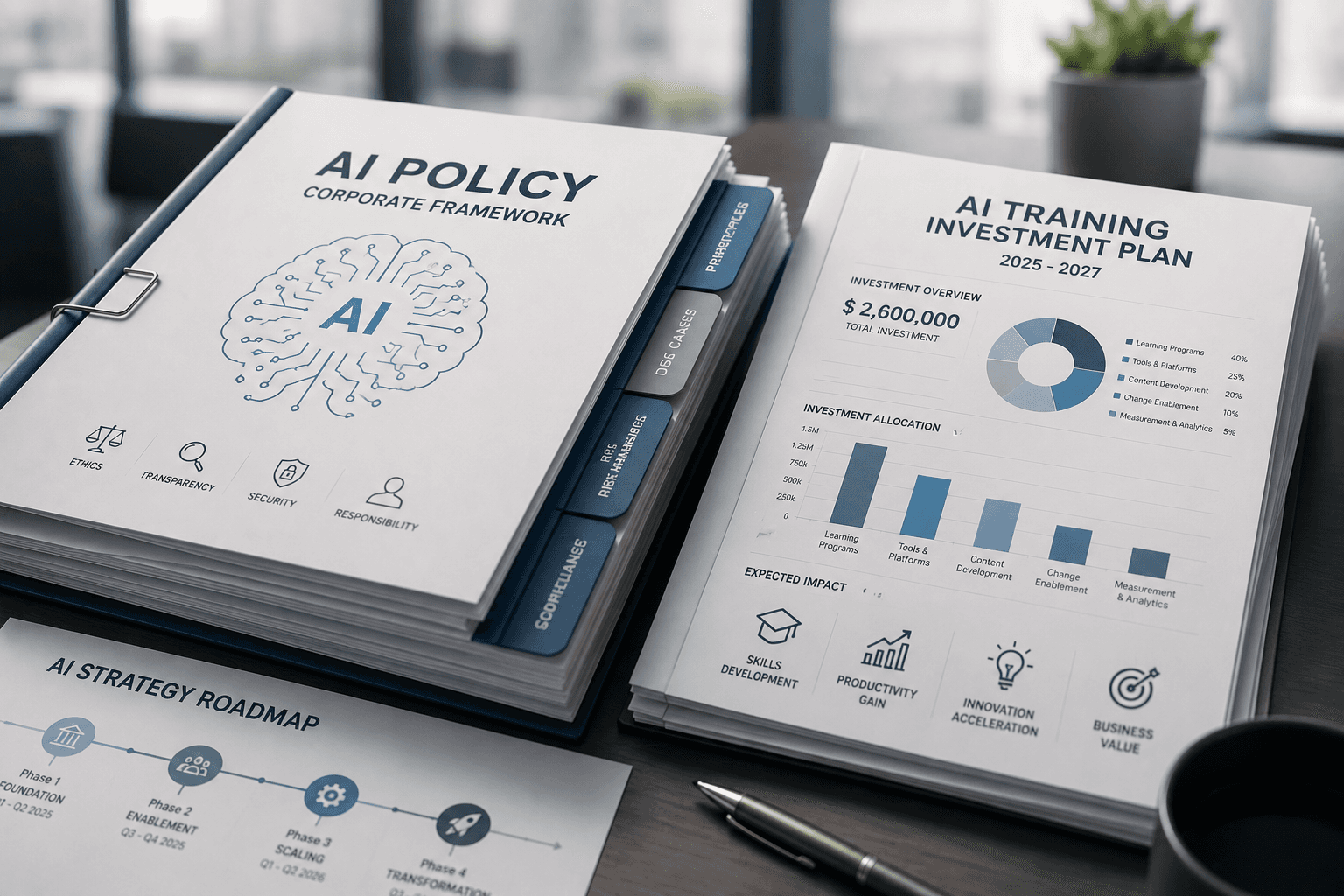
There is a common assumption in enterprise AI: that having a governance policy in place means governance is working. The data consistently shows otherwise.
75% of boards have approved major AI investments. Only 48% have set clear governance expectations alongside those investments (Grant Thornton, 2026). The approvals are happening. The accountability is not.
The Independent International Scientific Panel on AI, in its preliminary report published in July 2026 by the United Nations, identified the same pattern at a global scale. Dozens of governance instruments are already in use across jurisdictions, yet they are fragmented and rarely measure real-world effectiveness. Evaluation methods themselves are underdeveloped. The institutions needed to provide independent capability and risk assessments remain, in the Panel’s own words, embryonic.
This is not a problem unique to governments. Enterprise AI governance faces the same structural issue: organizations are creating policies faster than they are building the capacity to verify whether those policies work.
75% of organizations report having a dedicated AI governance process. Only 12% describe their efforts as mature (Cisco, 2026). Having governance and running governance are two very different things.
The Cost of Flying Blind
The governance gap is not abstract. It has a measurable price.

46% of leaders identify governance or compliance failures as the primary cause of AI underperformance or failure in their organization, making it the top reason cited ahead of insufficient training (31%) or data quality issues (23%) (Grant Thornton, 2026).
The incident data confirms the trend. The Stanford Human-centered Artificial Intelligence (HAI) AI Index 2026 recorded 362 documented AI incidents in 2025, up 56% from 233 the previous year. Incidents involving inaccurate outputs, data breaches tied to AI use, and legal claims are not waiting for governance programs to mature.
The performance gap is equally clear. Organizations with fully integrated AI and solid governance are nearly four times more likely to report revenue growth than those still in pilot stages: 58% versus 15% (Grant Thornton, 2026). The leading organizations can show how their AI makes decisions, who owns the outcomes, and what happens when something goes wrong. Most cannot.
The gap between those two positions is not primarily a technology gap. It is a governance gap.
Why Governance Programs Fail to Deliver
Most governance failures are not the result of bad intentions. They are the result of a structural problem: organizations are being asked to govern something they cannot yet fully see or measure.
The UN Scientific Panel identifies this directly.
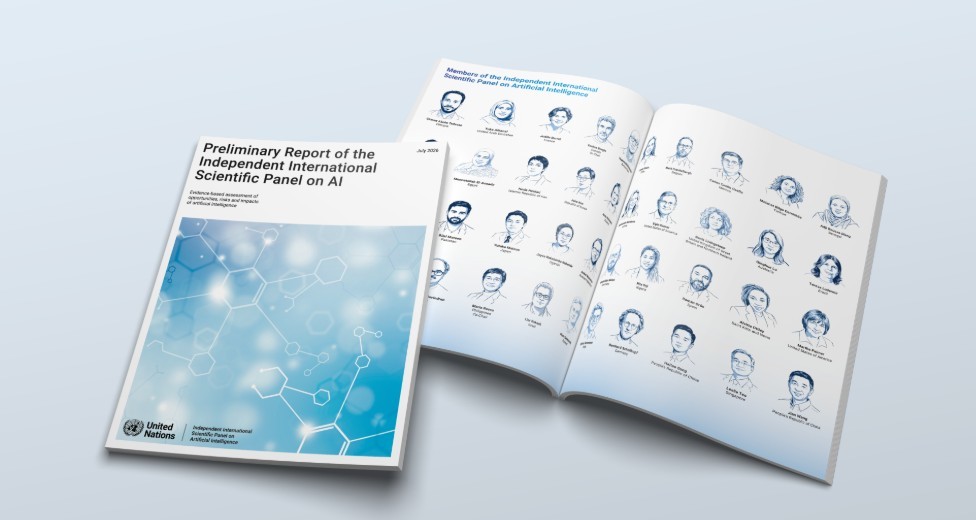
Policymakers need evidence to make informed governance decisions, but by the time the evidence exists, it may be too late to act, because evidence lags behind the pace of AI development. The same logic applies inside organizations. By the time a governance failure surfaces as an incident or a legal claim, the conditions that produced it have often been in place for months.
AI governance roles grew 17% in 2025 (Stanford HAI, 2026), yet the gap between role creation and governance maturity is widening, not closing. Creating a CAIO position does not solve the problem of knowing what AI is actually doing across the organization.
Three patterns consistently undermine AI governance programs:
• Accountability sits too high and too far from operations. Only 28% of organizations report that their CEO takes direct responsibility for AI governance oversight, and only 17% say their board does (McKinsey, 2025). Major decisions about AI use are being made daily at the team and function level, without governance visibility into those decisions.
• Metrics are missing. Tracking explicit AI Key Performance Indicators (KPIs) remains uncommon, even though it is one of the strongest correlates of long-term compliance and business impact (McKinsey, 2025). Organizations optimize for inputs they can measure: tools deployed, policies written, training completed. They rarely measure what matters: whether AI outputs are accurate, traceable, and aligned with business intent.
• The workforce is left out. Governance frameworks are designed at the top and assumed to operate at the bottom. But the people closest to AI-powered decision making, front-line employees and middle managers, are often the least supported. 37% of front-line employees and 30% of middle managers have been identified as those with the greatest need for AI support (Grant Thornton, 2026), yet only 6% of executives cite workforce enablement as a governance priority.
The Workforce Dimension Organizations Keep Missing
AI governance is not just a policy question. It is a people question.
A governance framework that employees do not understand is not a governance framework. It is a document. When employees do not know which AI tools they are permitted to use, what data they can input into AI systems, how to evaluate AI outputs critically, or when to escalate concerns, the governance policy exists in a different reality from the work being done.
This is precisely where AI governance training becomes a business-critical investment, not a compliance checkbox. 34% of finance leaders already identify AI training as underfunded in their organizations (Grant Thornton, 2026). The skills transformation required for responsible human-AI collaboration does not happen by issuing a policy. It requires structured corporate AI training that translates governance principles into daily practice.

Effective AI governance training for employees covers more than rules and restrictions. It develops the judgment to know when AI outputs can be trusted, the critical thinking to identify when they cannot, and the understanding of organizational accountability that turns individual behavior into collective governance.
This is a dimension that Mia AI builds into every AI upskilling program: governance is not a module at the end of a training program. It is a thread running through every stage of capability development, from foundational AI literacy through to applied skills and strategic decision-making.
What Effective AI Governance Actually Requires
The organizations closing the governance gap share a discipline: they built accountability structures before scaling deployment, not after. 74% of organizations with fully integrated AI are highly confident of passing an independent governance audit. Among those still in pilot stages, that figure is 7% (Grant Thornton, 2026).
The difference is not the technology. It is the sequence. Three conditions consistently appear in organizations that have closed the gap:
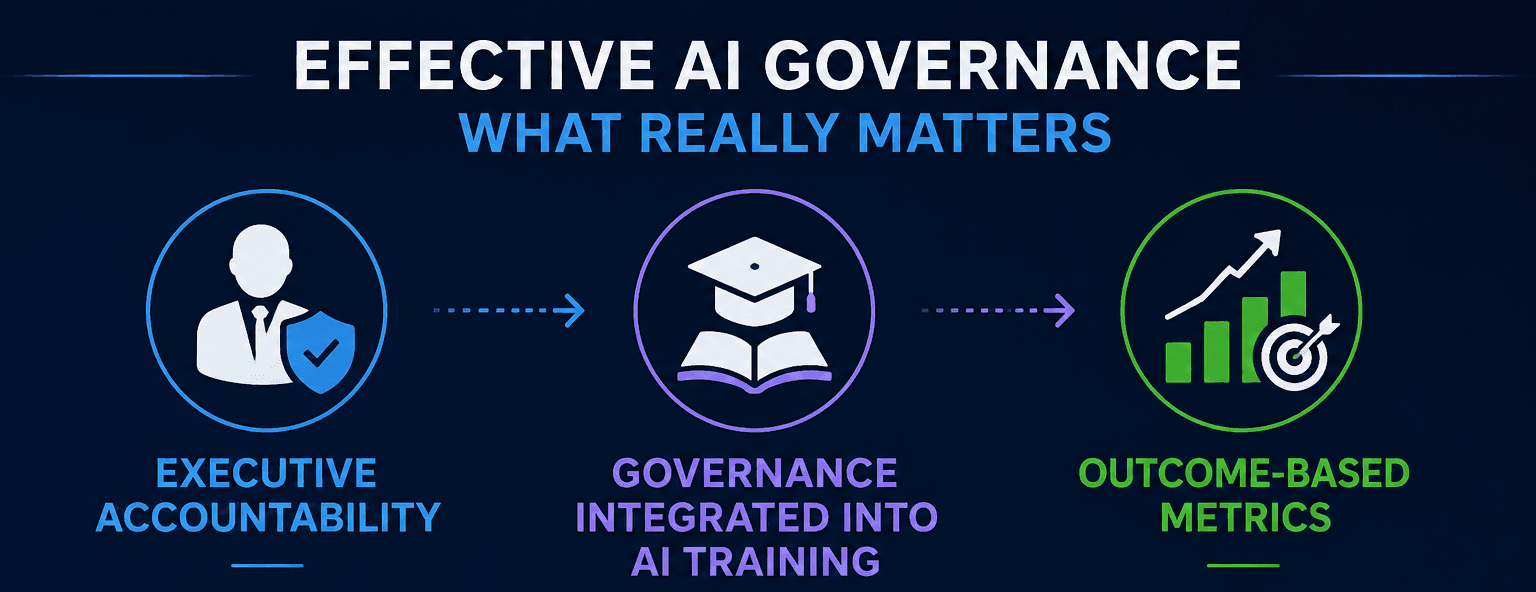
• Clear C-suite accountability. Not a governance committee, but named ownership at the executive level for AI outcomes, including when those outcomes fall short. Organizations where senior leadership takes direct accountability for AI governance consistently outperform those where it is delegated to a policy function.
• AI governance training integrated into AI training for organizations. Not delivered separately as a compliance requirement, but embedded as a foundational component of every AI capability program. Employees who understand governance at the point of application are more effective and less likely to create the conditions for incidents.
• Metrics connected to outcomes, not inputs. Tracking course completion rates, tools deployed, and policies written does not measure governance effectiveness. The metrics that matter are those connected to AI output accuracy, decision traceability, and workforce AI readiness at the role level.
The UN Scientific Panel makes a point that applies equally to enterprise AI: the capacity to act on existing evidence of AI risks is unevenly distributed. Most organizations lack the technical expertise to assess what their AI is actually doing. Access to AI tools alone does not produce safe or effective deployment. The complementary investments in skills, workflows, and institutions that turn access into responsible use are necessary and, right now, unequally distributed.
Governance Is Not a Brake on AI. It Is What Allows You to Scale.
The most common objection to investing in AI governance is that it slows things down. The data says the opposite.
Organizations that have built governance into their AI programs, not alongside them, are scaling faster, reporting higher revenue growth, and are four times more confident in their ability to withstand scrutiny. They are not moving slower. They are moving without the drag of invisible risk accumulating beneath the surface.
78% of executives cannot prove their AI is governed. That is not a compliance problem waiting to be solved. It is a strategic gap that compounds every quarter AI keeps scaling without it.
For organizations ready to close it, the starting point is not a new policy. It is building the human capability to make governance real at every level of the workforce. That is the work Mia AI is built to support.
Sources
Cisco. (2026, January). 2026 data and privacy benchmark study. Cisco. https://www.cisco.com/c/en/us/products/security/data-privacy-benchmark-study.html
Grant Thornton. (2026, April). 2026 AI impact survey report (Survey of 950 C-suite and senior leaders, 10 industries, February–March 2026). Grant Thornton. https://www.grantthornton.com/services/advisory-services/artificial-intelligence/2026-ai-impact-survey
Independent International Scientific Panel on AI. (2026, July). Preliminary report: Evidence-based assessment of opportunities, risks and impacts of artificial intelligence. Executive Summary. United Nations.
McKinsey & Company. (2025). The state of AI: Global survey 2025. McKinsey & Company. https://www.mckinsey.com/capabilities/quantumblack/our-insights/the-state-of-ai
Stanford Human-centered Artificial Intelligence (HAI). (2026, April). AI Index Report 2026: Responsible AI. Stanford University. https://hai.stanford.edu/ai-index/2026-ai-index-report/responsible-ai