
AI Literacy vs AI Skills: What’s the Difference?

Most organizations talk about AI literacy. Far fewer can tell you what their employees can actually do with AI.
54% of CEOs are already hiring for AI-related roles that did not exist a year ago. 31% of the global workforce will need reskilling within three years (IBM IBV, 2025). The jobs are changing faster than the people are being prepared.
And preparing people to talk about AI is not the same as preparing them to work with it. That distinction, between AI literacy and AI skills, is one of the most consequential gaps in enterprise AI strategy today.
Two Words. Two Very Different Things.
AI literacy and AI skills are often used interchangeably. They should not be.
AI literacy is the ability to understand AI: what it is, how it works, what it cannot do, and what risks it carries. According to OECD (2025), it centers on critical evaluation and human oversight. Knowing when to trust AI, when to question it, and when to override it. AI governance training sits here: which tools are approved, what data can be shared, how outputs should be reviewed.
AI skills are the applied capabilities required to use AI effectively in real work contexts: to prompt, iterate, integrate, evaluate, and produce results that create measurable value. Not knowing how a large language model works. Being able to use one to improve a business outcome.
AI literacy answers: "What is AI and why does it matter?" AI skills answer: "What can I do with AI that I could not do before?"
Both matter. But they are not the same investment, and they do not produce the same outcomes.
Why the Distinction Matters More Than Ever
The skills required in AI-exposed occupations are changing 66% faster than in other occupations, up from 25% the previous year. Roles requiring AI skills command a 56% wage premium over comparable roles that do not (PwC, 2025). Wages are growing twice as fast in AI-exposed industries.

Employers are not paying that premium for employees who understand what a neural network is. They are paying for employees who can use AI to produce better outcomes in specific business contexts.
An organization that invests in generic AI awareness programs and considers the job done has prepared its workforce to discuss AI, not to use it. In a market where skills are repricing this quickly, that gap is growing every quarter.
Where Most Organizations Get Stuck
Most corporate AI training programs are designed around literacy. They explain what generative AI is, cover prompting basics and responsible use. Valuable, but insufficient on their own.
Bridging the AI talent gap requires more than awareness. 80% of the engineering workforce will need to upskill by 2027, not because they need to understand AI better, but because their skill set must fundamentally shift (Gartner, 2024). That is a skills transformation, not a literacy initiative.
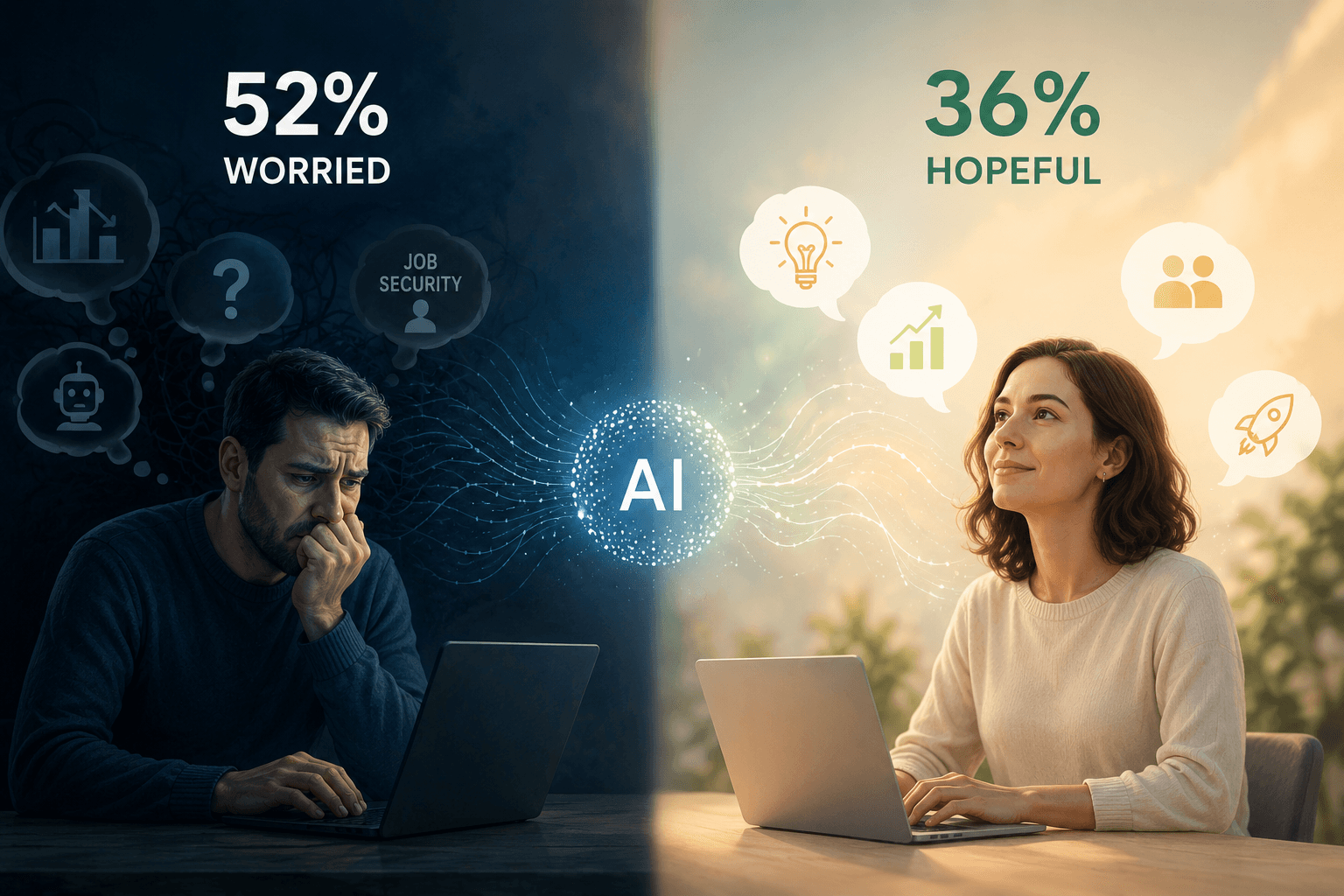
There is also an emotional dimension organizations underestimate. 52% of workers are worried about AI’s impact on their jobs, while only 36% feel hopeful (Pew Research Center, 2025). Literacy programs address this partially: they demystify AI and reduce fear. But anxiety about AI is not fully resolved by understanding it. It is resolved by being able to use it confidently.
The Four Levels of AI Capability
One practical way to navigate the literacy-to-skills distinction is a four-level progression: from foundational understanding to strategic transformation.
Level 1: Awareness
The employee knows AI exists, understands broadly what it can do, and recognizes its relevance to AI and the future of work in their industry. Most general communications and introductory programs stop here.
Level 2: Literacy
The employee understands how AI systems work conceptually, identifies limitations and risks, and applies critical judgment to AI outputs. AI governance training belongs here. Necessary, but not yet skill.
Level 3: Applied Skills
The employee uses AI effectively in their actual daily work: prompting, iterating, integrating AI outputs into real deliverables. Effective AI upskilling at this level is role-specific, hands-on, and measured by output quality. This is where business value starts to accumulate. Industries with high concentrations of employees at this level see 3x higher revenue growth per employee (PwC, 2025).
Level 4: Strategic Capability
The team has redesigned processes and workflows around AI, not just adapted existing ones. 65% of organizations plan to use automation to address skills gaps (IBM IBV, 2025), but automation delivers its full value only when the humans overseeing it operate at this level.
Most corporate AI training programs aim for Level 2. Most organizations need their workforce at Level 3.
What AI Skills Actually Look Like in Practice
The gap between literacy and skills is clearest at the level of specific roles.
A marketing professional with AI literacy knows generative AI can produce content. With AI skills, they have built a workflow that generates, tests, and optimizes campaign copy at scale, and knows exactly where human-AI collaboration needs human judgment to step in.
A finance analyst with AI literacy understands AI can introduce errors. With AI skills, they have rebuilt their reporting process, cut data compilation time, and now spend that time on interpretation and strategic analysis.
A manager with AI literacy knows to think critically about AI recommendations. With AI skills, they use AI-powered decision making to synthesize performance data, model scenarios, and produce decision-ready briefings, while applying the judgment that makes those briefings actionable.
In each case, literacy is the prerequisite. Skill is what changes the output.
Building Both: The Right Sequence
Literacy and skills are not in competition. They are sequential.
An employee who jumps to AI tools without foundational literacy is more likely to misuse AI and produce outputs they cannot evaluate. The 52% of workers anxious about AI are unlikely to engage confidently with tools they do not yet understand (Pew Research Center, 2025).
But stopping at literacy is equally incomplete. An organization whose AI upskilling efforts stop at awareness has addressed the anxiety without unlocking the value. The right sequence: build literacy first, including AI governance training that enables responsible engagement, then develop applied skills function by function, role by role, use case by use case.
This is the approach Mia AI is built around: a structured progression from awareness and literacy through to applied skills and strategic capability, designed around specific workflows and business contexts, not generic AI training courses delivered the same way to every employee regardless of role.
The Question to Ask Your Organization
Most organizations, when asked about AI readiness, answer in terms of literacy: programs run, courses deployed, completion rates achieved.
Those are not the wrong questions. They are the incomplete ones. Not "Do your employees understand AI?"

But "What can your employees do with AI that they could not do six months ago?"
The skills required in AI-exposed roles are evolving 66% faster than in other occupations (PwC, 2025). The answer to that question will look different in six months, regardless of what training programs are currently in place.
Organizations that treat AI literacy as the destination are preparing for the AI of the past. The ones building applied skills, through structured AI upskilling, role-specific programs, and continuous capability development, are building for what comes next.
Sources
IBM Institute for Business Value (IBM IBV). (2025, May 6). IBM CEO study: CEOs double down on AI while navigating enterprise hurdles. IBM Newsroom. https://newsroom.ibm.com/2025-05-06-ibm-study-ceos-double-down-on-ai-while-navigating-enterprise-hurdles
PwC. (2025, June 3). 2025 Global AI Jobs Barometer. PwC. https://www.pwc.com/gx/en/news-room/press-releases/2025/ai-linked-to-a-fourfold-increase-in-productivity-growth.html
Pew Research Center. (2025, February 25). U.S. workers are more worried than hopeful about future AI use in the workplace. https://www.pewresearch.org/social-trends/2025/02/25/u-s-workers-are-more-worried-than-hopeful-about-future-ai-use-in-the-workplace/
OECD. (2025). OECD guidance on AI literacy and workforce readiness. https://www.oecd.org/en/topics/sub-issues/ai-and-work.html
Gartner. (2024, October 3). Gartner says generative AI will require 80% of engineering workforce to upskill through 2027. https://www.gartner.com/en/newsroom/press-releases/2024-10-03-gartner-says-generative-ai-will-require-80-percent-of-engineering-workforce-to-upskill-through-2027