


Mia Editorial Team

Most business leaders have heard the term AI agent. Far fewer have a clear picture of what one actually does, how it differs from the AI tools already in use, and where it generates real business value.
This article answers those three questions, without jargon.
What makes an AI agent different from other AI tools
Generative AI creates content when you prompt it. You ask, it responds. The interaction stops there until you prompt again.
An AI agent does something different. It uses that same generative intelligence to plan, decide, and act across multiple steps and systems, with minimal human intervention between each step. It can read a support ticket, check account data, issue a fix, document the resolution, and escalate the exceptions that require human judgment, all as part of a single workflow (TechRev, 2026).
The practical distinction is significant. A generative AI tool makes an individual task faster. An AI agent changes how an entire workflow operates.
Where AI agents are delivering measurable business outcomes in 2026
The enterprise applications generating the clearest returns in 2026 are not the most technically complex. They are the most workflow-specific.
Customer operations is the leading use case. Organizations deploying AI agents for customer service are seeing 30 to 45% reductions in average handling time and first-contact resolution rate improvements of 15 to 25 percentage points compared to human-only baselines (McKinsey State of AI 2026, as cited by Heeya, 2026).
Document processing is the highest-ROI application in legal, finance, and healthcare. AI agents extract structured data from contracts, invoices, and forms, validate against business rules, and trigger appropriate workflows without manual intervention. Invoice processing that previously took days now takes hours. Healthcare organizations using AI agents for prior authorization and patient intake have reduced the administrative overhead that was consuming 30 to 40% of care coordination team time (Medium, 2026).
Software engineering is where adoption is furthest along. Developers using AI coding agents complete tasks 25 to 40% faster, with code review cycles shrinking by 30% (McKinsey 2026, as cited by Heeya, 2026). EY deployed an agentic coding platform across tens of thousands of consultants and reported a 70% lift in software development productivity.

Talent acquisition teams using generative AI report roughly a 20% workload reduction, approximately one working day per week (LinkedIn, as cited by TechRev, 2026). 43% of organizations used AI for HR and recruiting tasks in 2025, nearly double the prior year (SHRM, as cited by TechRev, 2026).
What separates organizations generating returns from those that are not
65% of organizations are using generative AI in at least one function. The gap between those generating 4x returns and those reporting no measurable impact comes down to three consistent factors, not technology quality (BBN Times, 2026).
First, use case specificity. The highest-ROI deployments apply AI to a specific, high-volume business process rather than providing a general-purpose tool to all employees. A well-defined workflow with measurable before-and-after is where agents deliver. An open-ended deployment without clear success criteria is where pilots stall.
Second, workflow redesign. Deloitte found that 84% of organizations have not redesigned roles around AI despite a 50% increase in worker access during 2025. Deploying an agent without changing the workflow it operates in captures only a fraction of the available value (TechRev, 2026).
Third, human oversight design. AI agents are not autonomous replacements for human judgment. The most successful enterprise deployments treat human-in-the-loop checkpoints not as a constraint but as a design principle. Agents handle volume and speed. Humans handle exceptions, judgment calls, and accountability.
What this means for your organization
A single-workflow AI agent integrated with existing systems typically deploys in 4 to 8 weeks (TechRev, 2026). The barrier to starting is lower than most organizations assume. The barrier to generating returns, however, is not technological. It is organizational: clear use case selection, workflow redesign, and the human capability to direct, validate, and govern what agents produce.
That human capability is what makes the difference between a pilot and a program. Building it requires the same structured ai upskilling and applied ai training for employees that effective AI adoption has always required, now applied to a more powerful and more consequential category of tools.
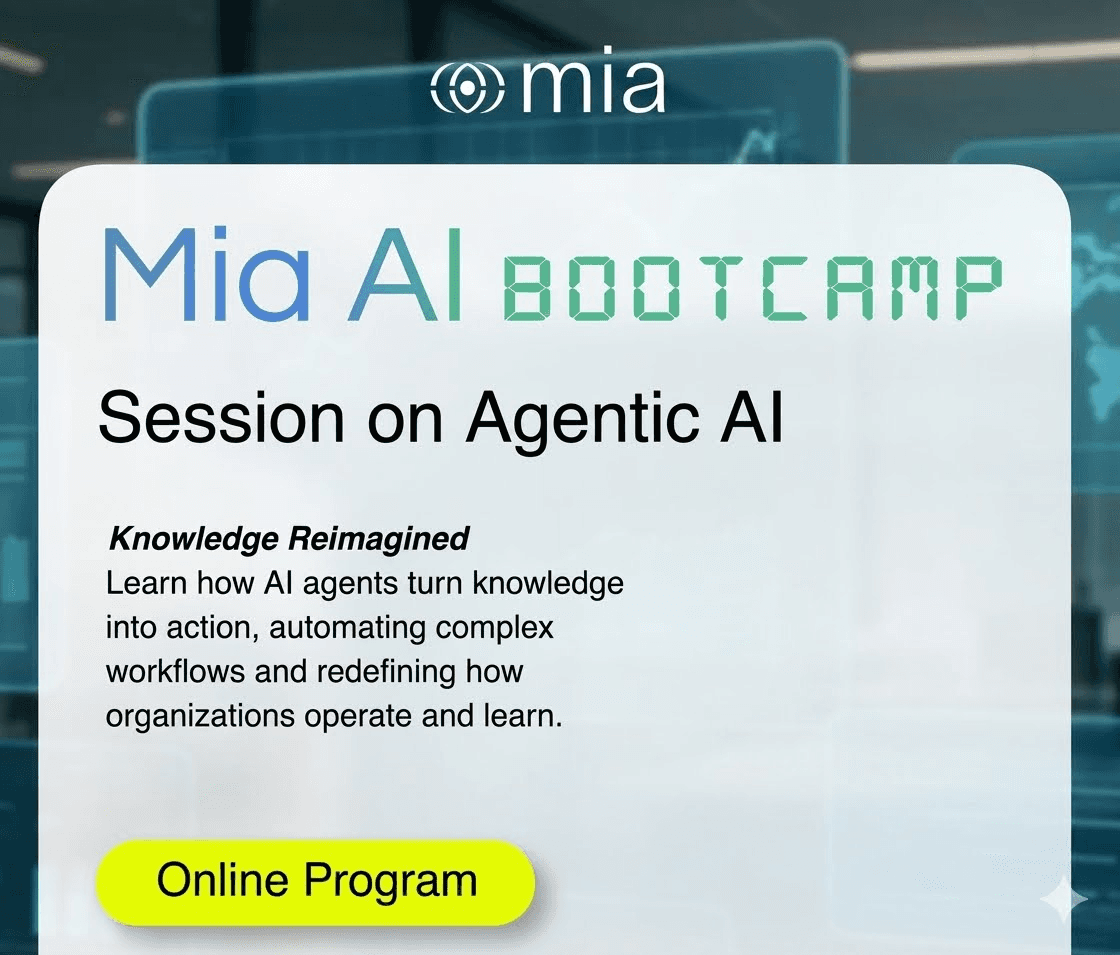
If you want to understand where your workforce stands on AI readiness today, that is where Mia AI starts.
Sources
BBN Times. (2026). Generative AI business use cases 2026: The 11 applications delivering real ROI. BBN Times. https://www.bbntimes.com/technology/generative-ai-business-use-cases-2026-the-11-applications-delivering-real-roi
Heeya. (2026, May 16). Generative AI enterprise ROI 2026: Use cases and numbers. Heeya. https://heeya.fr/en/blog/generative-ai-enterprise-roi-use-cases-2026
Medium / Pratik K Rupareliya. (2026, April 6). 5 generative AI use cases actually delivering ROI in 2026. Medium. https://medium.com/@pratik-rupareliya/5-generative-ai-use-cases-actually-delivering-roi-in-2026-and-the-architecture-behind-each-one-4e2b6db5b2c9
TechRev. (2026). Enterprise AI agents: What, use cases, and benefits in 2026. TechRev. https://www.techrev.us/blog/enterprise-ai-agents-what-use-cases-and-benefits-in-2026/
TechRev. (2026). Top generative AI use cases for businesses in 2026. TechRev. https://www.techrev.us/blog/top-generative-ai-use-cases-for-businesses-in-2026/
About